


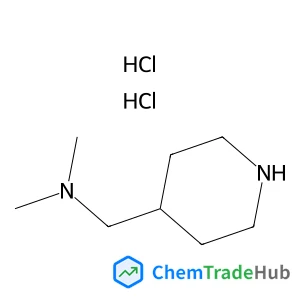
N,N-dimethyl(piperidin-4-yl)methanamine hydrochloride
CAS Number:
172281-72-0
Molecular Formula:
C8H20Cl2N2
Boyan Bonev, Anthony Watts, Marcus Bokvist, Gerhard Gröbner
High-resolution 31P magic angle spinning (MAS) NMR spectroscopy is presented as a direct and non-perturbing method for measuring changes in surface charge density occurring in mixed phospholipid membranes upon binding of charged surface-active peptides. 31P MAS NMR was used to investigate mixed lipid membranes of neutral phosphatidylcholine and negatively charged phosphatidylglycerol where the molar fraction of the charged lipid was varied from 0 to 1. The chemical shifts of the individual membrane lipids showed a simple variation in response to changes in the fraction of the negatively charged component phosphatidylglycerol. Addition of the positively charged amyloid-β1-40 peptide, a key substance in Alzheimer's disease, resulted in changes in the isotropic chemical shifts of the membrane lipid phosphates in a way consistent with reduction in the negative surface charge of the mixed lipid bilayers. Binding of different amounts of the positively charged peptide pentalysine to L-α-dioleoylphosphatidylcholine/L-α-dioleoylphosphatidylglycerol (DOPC/DOPG) vesicles (2:1 molar ratio) also showed a systematic variation of both chemical shift values. These changes were described by a simple two-site model and indicate purely electrostatic binding of pentalysine.

Russian Chemical Bulletin

Chemical Communications

Organic Process Research & Development

Current Opinion in Solid State & Materials Science

Russian Journal of General Chemistry

Saudi Pharmaceutical Journal

Russian Journal of Bioorganic Chemistry

Journal of Saudi Chemical Society

Crystallography Reports

Nature Medicine
Raimundo R. Gamela, Marco A. Sperança, Daniel F. Andrade, Edenir R. Pereira-Filho
DOI: 10.1039/C9AY01916B
Jia-Ju Fu, Tingting Zheng, Jun-Jie Zhu
DOI: 10.1039/C3AN01255G
Jiawei Li, Ping Yang, Jing Zhang, Zhengfan Shui, Danqun Huo, Changjun Hou
DOI: 10.1039/C9AY01804B
Weijia Leng, Kimberly Evans, Michael G. Roper
DOI: 10.1039/C9AY01758E
Jichao Zhang, Yi Zhang, Aiguo Li, Xiaohan Yu, Qing Huang, Chunhai Fan, Xiaoqing Cai
DOI: 10.1039/C3AN01267K
Lijiao Tian, Yong Guan, Liang Chen, Gang Liu, Han-qing Yu, Yangchao Tian
DOI: 10.1039/D0AN00507J
Ping Wu, Yang Gao, Yimei Lu, Hui Zhang, Chenxin Cai
DOI: 10.1039/C3AN01375H
Ethyl 4-chlorothieno[2,3-b]pyridine-5-carboxylate (CAS: 59713-58-5) can be synth...
5-Methyl-1H-indole-3-carbaldehyde (CAS: 52562-50-2) is subject to various regula...
(1,3-Dimethyl-2,4-dioxo-1,2,3,4-tetrahydro-5-pyrimidinyl)boronic acid is a white...
Waste containing Sulfocostunolide A (CAS: 1016983-51-9) should be handled with c...
When handling Murraxocin (CAS: 88478-44-8), ensure proper personal protective eq...
Formvar (CAS: 63148-64-1) is an alkyd resin characterized by a high molecular we...
(S)-4-benzyl-2-((benzyloxy)methyl)morpholine is generally safe when handled with...
Methyl 1-(5-bromo-2-pyrimidinyl)cyclopropanecarboxylate (CAS: 1447607-69-3) is p...
2-Methyl-1-phenyl-1-propanamine hydrochloride (CAS: 24290-47-9) is generally con...
3-(4-Bromophenyl)-2-methylpropanoic acid is synthesized through a multi-step pro...

Physical Chemistry Chemical Physics (PCCP) is an international journal co-owned by 19 physical chemistry and physics societies from around the world. This journal publishes original, cutting-edge research in physical chemistry, chemical physics and biophysical chemistry. To be suitable for publication in PCCP, articles must include significant innovation and/or insight into physical chemistry; this is the most important criterion that reviewers and Editors will judge against when evaluating submissions. The journal has a broad scope and welcomes contributions spanning experiment, theory, computation and data science. Topical coverage includes spectroscopy, dynamics, kinetics, statistical mechanics, thermodynamics, electrochemistry, catalysis, surface science, quantum mechanics, quantum computing and machine learning. Interdisciplinary research areas such as polymers and soft matter, materials, nanoscience, energy, surfaces/interfaces, and biophysical chemistry are welcomed if they demonstrate significant innovation and/or insight into physical chemistry. Joined experimental/theoretical studies are particularly appreciated when complementary and based on up-to-date approaches.
![4-[(1-Methyl-1H-pyrrol-2-yl)methylene]-1,3(2H,4H)-isoquinolinedione structure](https://static.chemtradehub.com/structs/110/1104546-89-5-a600.webp "4-[(1-Methyl-1H-pyrrol-2-yl)methylene]-1,3(2H,4H)-isoquinolinedione structure")

![Imidazo[1,5-a]pyrazine structure](https://static.chemtradehub.com/structs/274/274-49-7-d749.webp "Imidazo[1,5-a]pyrazine structure")



