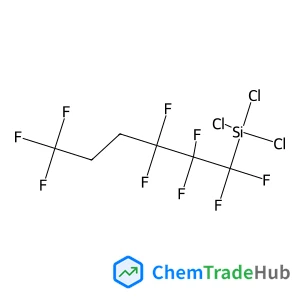
Trichloro(3,3,4,4,5,5,6,6,6-nonafluorohexyl)silane
CAS Number:
78560-47-1
Molecular Formula:
C6H4Cl3F9Si
Ken-ichi Shimizu, Junji Shibata, Atsushi Satsuma, Tadashi Hattori
Ag–Al2O3 catalyst prepared by the sol–gel method was studied for the selective catalytic reduction (SCR) of NO by various hydrocarbons (HC-SCR). The rates of NO reduction and hydrocarbon conversion depend strongly on the type of hydrocarbon reductant; the rates were higher for the higher normal alkanes, higher for alkene than alkane, and higher for normal alkane than branched alkane. The formation and reaction of hydrocarbon-derived species adsorbed on the surface were investigated by in situ FTIR spectroscopy. The apparent rate of acetate formation in the hydrocarbon + O2 reaction and the rate of nitrate reaction in hydrocarbon + O2 also depend on the nature of the hydrocarbon with a similar activity pattern to that for the SCR reaction. For the various hydrocarbons used, the rate of nitrate reaction in hydrocarbon + O2 was close to the steady-state rate of NO reduction, indicating that the nitrate is a possible intermediate in this reaction. The reaction of nitrates with oxygenated hydrocarbon species, possibly the acetate, was proposed to be a crucial step in HC-SCR. A proposed mechanism explains the hydrocarbon effect on the de-NOx activity: the NO reduction activity depends on the reactivity of the hydrocarbon molecule, which affects the rate of hydrocarbon oxidation to oxygenates and hence the rate of nitrate reaction with oxygenated hydrocarbons.
Jun-Song Zhong, Yi Yu, Zhaojiang Shi, Ke-Yin Ye
DOI: 10.1039/D0QO01227K
Xinyu Zhang, Dan Wang, Hao Shen, Shuxian Wang, Yunbing Zhou, Yunxiang Lei, Wenxia Gao, Miaochang Liu, Xiaobo Huang, Huayue Wu
DOI: 10.1039/D0QO01527J
Mingjun Zhang, Xin Ding, Aidang Lu, Jin Kang, Yongyue Gao, Ziwen Wang, Hongyan Li, Qingmin Wang
DOI: 10.1039/D0QO01413C
Rui Guo, Peng Zhao, Xiaoqi Yu, Guodong Yao, Bin Lin, Xiaoxiao Huang, Shaojiang Song
DOI: 10.1039/D0QO01475C
Torben Lund, Peter Christensen, Robert Wilbrandt
DOI: 10.1039/B209594G
Ying Wen, Zhiqing Long, Fangjun Huo, Caixia Yin
DOI: 10.1039/D0QO01260B
Carsten Schmuck, Martin Heil
DOI: 10.1039/B211425A
Donie Guiney, Colin L. Gibson, Colin J. Suckling
DOI: 10.1039/B211564F
Ethyl 3-cyclohexylpropanoate is a clear, colorless to light yellow liquid with a...
Waste containing 2-(Hydroxymethyl)-5-(methoxycarbonyl)-6-methyl-4-(2-nitrophenyl...
Waste containing 2,4,6-Tris(pentafluoroethyl)-1,3,5-triazine (CAS: 858-46-8) sho...
When handling Chloroac-nle-oh (CAS: 56787-36-1), it is essential to wear appropr...
Ethyl 6-phenylimidazo[2,1-b][1,3]thiazole-3-carboxylate is primarily used in the...
Alternatives to alpha-(2-Bromophenyl)benzylamine (CAS: 55095-15-3) in synthesis ...
Waste containing 2-Chloro-5-methoxypyridine (CAS: 139585-48-1) should be managed...
1-(4-Methoxyphenyl)-2,5-dimethyl-1H-pyrrole (CAS: 5044-27-9) is used in various ...
There are alternative reagents and compounds that can be used in the synthesis o...
Tungsten(IV) oxide, also known as tungsten dioxide, is a chemical compound with ...

Physical Chemistry Chemical Physics (PCCP) is an international journal co-owned by 19 physical chemistry and physics societies from around the world. This journal publishes original, cutting-edge research in physical chemistry, chemical physics and biophysical chemistry. To be suitable for publication in PCCP, articles must include significant innovation and/or insight into physical chemistry; this is the most important criterion that reviewers and Editors will judge against when evaluating submissions. The journal has a broad scope and welcomes contributions spanning experiment, theory, computation and data science. Topical coverage includes spectroscopy, dynamics, kinetics, statistical mechanics, thermodynamics, electrochemistry, catalysis, surface science, quantum mechanics, quantum computing and machine learning. Interdisciplinary research areas such as polymers and soft matter, materials, nanoscience, energy, surfaces/interfaces, and biophysical chemistry are welcomed if they demonstrate significant innovation and/or insight into physical chemistry. Joined experimental/theoretical studies are particularly appreciated when complementary and based on up-to-date approaches.
![Sodium 4-{2-[(E)-2-{(3E)-3-{(2E)-2-[3,3-dimethyl-1-(4-sulfonatobutyl)-1,3-dihydro-2H-indol-2-ylidene]ethylidene}-2-[(4-isothiocyanatophenyl)sulfanyl]-1-cyclohexen-1-yl}vinyl]-3,3-dimethyl-3H-indolium-
1-yl}-1-butanesulfonate structure](https://static.chemtradehub.com/structs/152/152111-91-6-e5df.webp "Sodium 4-{2-[(E)-2-{(3E)-3-{(2E)-2-[3,3-dimethyl-1-(4-sulfonatobutyl)-1,3-dihydro-2H-indol-2-ylidene]ethylidene}-2-[(4-isothiocyanatophenyl)sulfanyl]-1-cyclohexen-1-yl}vinyl]-3,3-dimethyl-3H-indolium-
1-yl}-1-butanesulfonate structure")