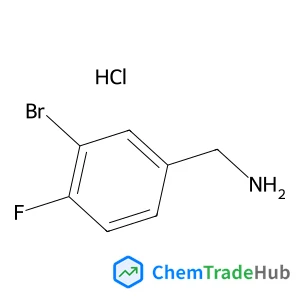
1-(3-Bromo-4-fluorophenyl)methanamine hydrochloride (1:1)
CAS Number:
202865-68-7
Molecular Formula:
C7H8BrClFN
The recombination reactions O + NO2(+M) → NO3(+M) and NO2 + NO3(+M) → N2O5(+M) were studied at temperatures of 300 and 400 K, and at pressures of the bath gas M = N2 between 1 and 900 bar. Oxygen atoms were generated by laser flash photolysis of N2O at 193 nm, NO3 radicals were monitored by light absorption at 578 nm. The measured fall-off curve of the reaction O + NO2(+M) → NO3(+M) could be well represented by limiting low pressure rate constants k3,0 = (1.3 ± 0.3) × 10−31 (T/300 K)−1.5 [N2] cm6 molecule−2 s−1, limiting high pressure rate constants k3,∞ = (2.3 ± 0.2) × 10−11 (T/300 K)0.24 cm molecule−1 s−1, and fall-off broadening factors of Fc = 0.71 exp(−T/1700 K). The derived results are consistent with earlier relative rate measurements. Theoretical modeling of k3,0, Fc and k3,∞ led to consistency with the experimental data. There is strong evidence that, besides the electronic ground state NO3(2A′), the first excited electronic state NO3(2E′) also contributes to the observed recombination reaction. The measured fall-off curve of the reaction NO2 + NO3(+M) → N2O5(+M) was represented by limiting low pressure rate constants k5,0 = 3.6 × 10⁻³⁰(T/300 K)−5.0 [N2] cm6 molecule−2 s−1, limiting high pressure rate constants k5,∞ = (1.9 ± 0.3) × 10−12(T/300 K)0.2 cm3 molecule−1 s−1 and Fc = 0.38 exp(−T/4900 K). A theoretical analysis of these values is also presented.
Lin Yang, Hua-Jie Wang, Hua-Yan Yang, Shan-Hu Liu, Bao-Fang Zhang, Kui Wang, Xiao-Ming Ma, Zhi Zheng
DOI: 10.1039/B804274H
Xizhe Liu, Yanhong Luo, Hong Li, Yuzun Fan, Zhexun Yu, Yuan Lin, Liquan Chen, Qingbo Meng
DOI: 10.1039/B700472A
Yajun Tian, Huaixin Yang, Shuanglin Zhan, Yunfa Chen
DOI: 10.1039/B801966E
Lixia Sun, Qianwang Chen, Yan Tang, Ying Xiong
DOI: 10.1039/B704689H
Fabrice Goubard, Pierre-Henri Aubert, Kada Boukerma, Emmanuel Pauthe, Claude Chevrot
DOI: 10.1039/B800754C
Arjan Odedra, Karolin Geyer, Tomas Gustafsson, Ryan Gilmour, Peter H. Seeberger
DOI: 10.1039/B803715A
Claude Villiers, Pierre Thuéry, Michel Ephritikhine
DOI: 10.1039/B705224C
When considering alternatives to 1-(4-Chlorophenyl)-N-hydroxymethanimine (CAS: 3...
This compound should be stored in a cool, dry place away from direct sunlight. I...
3-(4-Bromophenyl)-5-(2-fluorophenyl)-1,2,4-oxadiazole is synthesized through a m...
5-Chloro-2-(4-chlorophenyl)-4-methyl-6-[3-(1-piperidinyl)propoxy]pyrimidine (CAS...
2-Chloro-4-(difluoromethoxy)pyridine is used in the pharmaceutical industry for ...
3-Chloro-6-methylpyridazine (CAS: 1121-79-5) is classified under the Globally Ha...
Several alternatives can be used in the synthesis of Methyl 4,5-dimethyl-2-nitro...
Alternatives to (2E,2'E)-3,3'-(1,4-Phenylene)bisacrylaldehyde include other acry...
3-Amino-5-chloropyridin-2-ol hydrochloride is an organic compound with the CAS n...
When handling 6,7-Difluoro-2,3-dihydro-4H-chromen-4-one, it is essential to wear...

Physical Chemistry Chemical Physics (PCCP) is an international journal co-owned by 19 physical chemistry and physics societies from around the world. This journal publishes original, cutting-edge research in physical chemistry, chemical physics and biophysical chemistry. To be suitable for publication in PCCP, articles must include significant innovation and/or insight into physical chemistry; this is the most important criterion that reviewers and Editors will judge against when evaluating submissions. The journal has a broad scope and welcomes contributions spanning experiment, theory, computation and data science. Topical coverage includes spectroscopy, dynamics, kinetics, statistical mechanics, thermodynamics, electrochemistry, catalysis, surface science, quantum mechanics, quantum computing and machine learning. Interdisciplinary research areas such as polymers and soft matter, materials, nanoscience, energy, surfaces/interfaces, and biophysical chemistry are welcomed if they demonstrate significant innovation and/or insight into physical chemistry. Joined experimental/theoretical studies are particularly appreciated when complementary and based on up-to-date approaches.
![(2S)-2-{[(9H-Fluoren-9-ylmethoxy)carbonyl]amino}-4-(methylselanyl)butanoic acid structure](https://static.chemtradehub.com/structs/121/1217852-49-7-f252.webp "(2S)-2-{[(9H-Fluoren-9-ylmethoxy)carbonyl]amino}-4-(methylselanyl)butanoic acid structure")