












Note on the use of maize as an adulterant of oatmeal
Literature Information
Publication Date
DOI
10.1039/AN8952000030
Impact Factor
4.616
Authors
View Original
Abstract
The first page of this article is displayed as the abstract.
Related Literature
Thermo and pH dual-responsive drug-linked pseudo-polypeptide micelles with a comb-shaped polymer as a micellar exterior
Weizhi Chen, Liling Su, Peng Zhang, Cheng Li, Dan Zhang, Wei Wu, Xiqun Jiang
2017-10-17
Paper
DOI: 10.1039/C7PY01389B
First observation of an ordered microphase in melts of poly(oxyethylene)–poly(oxypropylene) block copolymers
J. Patrick A. Fairclough, Ga-Er Yu, Shao-Min Mai, Michael Crothers, Kell Mortensen, Anthony J. Ryan, and Colin Booth
2000-03-10
Paper
DOI: 10.1039/A909182C
Fully recoverable rigid shape memory foam based on copper-catalyzed azide–alkyne cycloaddition (CuAAC) using a salt leaching technique
Abeer A. Alzahrani, Mohand Saed, Christopher M. Yakacki, Han Byul Song, Nancy Sowan, Joshua J. Walston, Parag K. Shah, Matthew K. McBride
2017-11-29
Paper
DOI: 10.1039/C7PY01121K
Wavepacket propagation for reactive scattering using real L 2 eigenfunctions with damping
Sergei Skokov, Joel M. Bowman
2000-02-07
Paper
DOI: 10.1039/A907983A
Methacrylate-ended polypeptides and polypeptoids for antimicrobial and antifouling coatings
Qiang Gao, Peng Li, Hongyang Zhao, Yashao Chen, Liu Jiang
2017-09-26
Paper
DOI: 10.1039/C7PY01495C
Prediction of the carrier-mediated cation flux through polymer inclusion membranes via fundamental thermodynamic quantities: complexation study of bis(dodecyloxy)calix[4]arene-crown-6 with alkali metal cations
Dusten M. Macdonald, John D. Lamb, Bruce A. Moyer
2000-03-20
Paper
DOI: 10.1039/A908840G
Correction: The effect of ligand, solvent and Cu(0) source on the efficient polymerization of polyether acrylates and methacrylates in aqueous and organic media
Alexandre Simula, Vasiliki Nikolaou, Fehaid Alsubaie
2017-11-28
Correction
DOI: 10.1039/C7PY90191G
You might also like
Compound Q&A
How is Ethyl 4-chlorothieno[2,3-b]pyridine-5-carboxylate (CAS: 59713-58-5) typically synthesized?
Ethyl 4-chlorothieno[2,3-b]pyridine-5-carboxylate (CAS: 59713-58-5) can be synth...
59713-58-5Ethyl 4-chlorothieno...
Compound Q&A
What regulatory guidelines apply to 5-Methyl-1H-indole-3-carbaldehyde (CAS: 52562-50-2)?
5-Methyl-1H-indole-3-carbaldehyde (CAS: 52562-50-2) is subject to various regula...
52562-50-25-Methyl-1H-indole-3...
Compound Q&A
What are the physical and chemical properties of (1,3-Dimethyl-2,4-dioxo-1,2,3,4-tetrahydro-5-pyrimidinyl)boronic acid (CAS: 223418-73-3)?
(1,3-Dimethyl-2,4-dioxo-1,2,3,4-tetrahydro-5-pyrimidinyl)boronic acid is a white...
223418-73-3(1,3-Dimethyl-2,4-di...
Compound Q&A
How should waste containing Sulfocostunolide A (CAS: 1016983-51-9) be handled?
Waste containing Sulfocostunolide A (CAS: 1016983-51-9) should be handled with c...
1016983-51-9Sulfocostunolide A
Compound Q&A
What precautions should be taken when handling Murraxocin (CAS: 88478-44-8)?
When handling Murraxocin (CAS: 88478-44-8), ensure proper personal protective eq...
88478-44-8Murraxocin
Compound Q&A
What are the physical and chemical properties of Formvar (CAS: 63148-64-1)?
Formvar (CAS: 63148-64-1) is an alkyd resin characterized by a high molecular we...
63148-64-1Formvar(R)
Compound Q&A
Is (S)-4-benzyl-2-((benzyloxy)methyl)morpholine (CAS: 205242-66-6) safe?
(S)-4-benzyl-2-((benzyloxy)methyl)morpholine is generally safe when handled with...
205242-66-6(S)-4-benzyl-2-((ben...
Compound Q&A
What industries use Methyl 1-(5-bromo-2-pyrimidinyl)cyclopropanecarboxylate (CAS: 1447607-69-3)?
Methyl 1-(5-bromo-2-pyrimidinyl)cyclopropanecarboxylate (CAS: 1447607-69-3) is p...
1447607-69-3Methyl 1-(5-bromo-2-...
Compound Q&A
Is 2-Methyl-1-phenyl-1-propanamine hydrochloride (CAS: 24290-47-9) safe?
2-Methyl-1-phenyl-1-propanamine hydrochloride (CAS: 24290-47-9) is generally con...
24290-47-92-Methyl-1-phenyl-1-...
Compound Q&A
How is 3-(4-Bromophenyl)-2-methylpropanoic acid (CAS: 66735-01-1) typically synthesized?
3-(4-Bromophenyl)-2-methylpropanoic acid is synthesized through a multi-step pro...
66735-01-13-(4-Bromophenyl)-2-...
Source Journal
Analyst

CiteScore:
7.8
Self-citation Rate:
5.6%
Articles per Year:
653
Analyst publishes analytical and bioanalytical research that reports premier fundamental discoveries and inventions, and the applications of those discoveries, unconfined by traditional discipline barriers.
Recommended Compounds
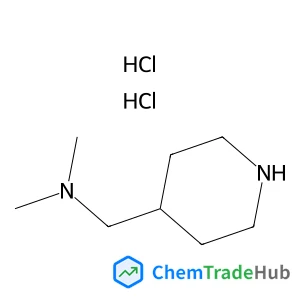
N,N-dimethyl(piperidin-4-yl)methanamine hydrochloride
CAS Number:
172281-72-0
Molecular Formula:
C8H20Cl2N2


Recommended Suppliers






Disclaimer
This page provides academic journal information for reference and research purposes only. We are not affiliated with any journal publishers and do not handle publication submissions. For publication-related inquiries, please contact the respective journal publishers directly.
If you notice any inaccuracies in the information displayed, please contact us at support@chemtradehub.com. We will promptly review and address your concerns.