












Electrospray mass spectrometry and collision-induced fragmentation of 2-aminobenzamide-labelled neutral N-linked glycans
Literature Information
Publication Date
2000-03-27
DOI
10.1039/A908997G
Impact Factor
4.616
Authors
View Original
Abstract
The positive ion fragmentation spectra of the singly- and doubly-charged sodiated adducts from high-mannose, hybrid and complex N-linked glycans, labelled at the reducing terminus with 2-aminobenzamide (2-AB), were examined using electrospray ionization and collision-induced decomposition on a hybrid Q-TOF instrument. [M + Na]+ ions, whose abundance could be enhanced by operating the ion source at a high cone-voltage, gave the most informative spectra but, because the relative abundance of the singly-charged ions fell as a function of mass to a greater extent than the abundance of the doubly-sodiated ions, the latter were more useful for larger glycans. The spectra were more complicated than those obtained from protonated adducts but simpler than those of the underivatised glycans. Although the spectra from both hydrogen and sodium adducts were dominated by ions formed by B- and Y-type glycosidic cleavages, those from the sodium adducts were more complex and contained additional C and Z ions together with products of cross-ring cleavages yielding linkage information. Many fragment ions were formed via multiple pathways by losses of sugar residues from different regions of the molecule (internal fragments). The presence of the reducing-terminal 2-AB derivative effectively labelled this region of the molecule, thus simplifying spectral interpretation. Structural features identified by this technique included the isobaric monosaccharide composition, presence or absence of a core (reducing-terminal) linked fucose and ‘bisecting’ (4-linked to the branching core mannose) GlcNAc residue together with information on the branching patterns.
Related Literature
Electronic state-lifetime interference in resonant Auger spectra: a tool to disentangle overlapping core-excited states
Gildas Goldsztejn, Denis Céolin, Rajesh K. Kushawaha, Ralph Püttner
2016-05-06
Paper
DOI: 10.1039/C6CP01998F
On the gas phase fragmentation of protonated uracil: a statistical perspective
Emilio Martínez-Núñez
2016-05-05
Paper
DOI: 10.1039/C6CP01657J
Redox potentials of aryl derivatives from hybrid functional based first principles molecular dynamics
Xiandong Liu, Xiancai Lu, Mengjia He, Rucheng Wang
2016-05-04
Paper
DOI: 10.1039/C6CP01375A
Pressure dependent low temperature kinetics for CN + CH3CN: competition between chemical reaction and van der Waals complex formation
Chantal Sleiman, Sergio González, Stephen J. Klippenstein, Dahbia Talbi, Gisèle El Dib, André Canosa
2016-05-10
Paper
DOI: 10.1039/C6CP01982J
Structural investigations on a linear isolated depsipeptide: the importance of dispersion interactions
A. Stamm, D. Bernhard, M. Gerhards
2016-05-05
Paper
DOI: 10.1039/C6CP01675H
Connectivity matters – ultrafast isomerization dynamics of bisazobenzene photoswitches
Chavdar Slavov, Chong Yang, Luca Schweighauser, Chokri Boumrifak, Andreas Dreuw, Hermann A. Wegner, Josef Wachtveitl
2016-03-09
Paper
DOI: 10.1039/C6CP00603E
Enhanced electrical properties and field emission characteristics of AZO/ZnO-nanowire core–shell structures
Jheng-Ming Huang, Shang-You Tsai, Ching-Shun Ku, Chih-Ming Lin, San-Yuan Chen
2016-05-09
Paper
DOI: 10.1039/C6CP01011C
Characterization of water dissociation on α-Al2O3(102): theory and experiment
Jonas Wirth, Harald Kirsch, Sebastian Wlosczyk, Yujin Tong, Peter Saalfrank, R. Kramer Campen
2016-04-18
Paper
DOI: 10.1039/C6CP01397J
Solvent-induced desorption of alkanethiol ligands from Au nanoparticles
Yuanyuan Huang, Wei Liu, Hao Cheng, Tao Yao, Lina Yang, Jie Bao, Ting Huang, Zhihu Sun, Yong Jiang, Shiqiang Wei
2016-05-17
Paper
DOI: 10.1039/C6CP00480F
You might also like
Compound Q&A
Is 4-Benzyl-2,2-dimethylmorpholine (CAS: 84761-04-6) safe?
4-Benzyl-2,2-dimethylmorpholine is generally considered safe when handled under ...
84761-04-64-Benzyl-2,2-dimethy...
Compound Q&A
What is (5,6-Dimethoxy-3-pyridinyl)boronic acid (CAS: 1346526-61-1)?
(5,6-Dimethoxy-3-pyridinyl)boronic acid is a chemical compound with the molecula...
1346526-61-1(5,6-Dimethoxy-3-pyr...
Compound Q&A
How is 1,1,3,3-Tetramethyl-1,3-bis(2-methyl-2-propanyl)disiloxane (CAS: 67875-55-2) typically synthesized?
1,1,3,3-Tetramethyl-1,3-bis(2-methyl-2-propanyl)disiloxane is synthesized throug...
67875-55-21,1,3,3-Tetramethyl-...
Compound Q&A
What are the main uses of (2R,4S)-1-Boc-4-methylpyrrolidine-2-carboxylic acid (CAS: 1018818-04-6)?
(2R,4S)-1-Boc-4-methylpyrrolidine-2-carboxylic acid is primarily used as a build...
1018818-04-6(2R,4S)-1-Boc-4-meth...
Compound Q&A
What precautions should be taken when handling 2,3-Dichloroacrylonitrile (CAS: 22410-58-8)?
When handling 2,3-Dichloroacrylonitrile, it is crucial to wear appropriate perso...
22410-58-82,3-Dichloroacryloni...
Compound Q&A
How should (S)-1-(o-Tolyl)ethanamine hydrochloride (CAS: 1332832-16-2) be stored?
(S)-1-(o-Tolyl)ethanamine hydrochloride should be stored in a cool, dry place to...
1332832-16-2(S)-1-(o-Tolyl)ethan...
Compound Q&A
What are the physical and chemical properties of Benzyl [1-(hydroxyamino)-1-imino-2-methyl-2-propanyl]carbamate (CAS: 518047-98-8)?
Benzyl [1-(hydroxyamino)-1-imino-2-methyl-2-propanyl]carbamate (CAS: 518047-98-8...
518047-98-8Benzyl [1-(hydroxyam...
Compound Q&A
What industries use 2-Methyloxazole-5-carbaldehyde (CAS: 885273-42-7)?
2-Methyloxazole-5-carbaldehyde is used in the pharmaceutical industry for the sy...
885273-42-72-Methyloxazole-5-ca...
Compound Q&A
What is the market or research trend for 2-Methyl-2-propanyl 4-[(1S)-1-hydroxyethyl]-1-piperidinecarboxylate (CAS: 389889-82-1)?
The market for 2-Methyl-2-propanyl 4-[(1S)-1-hydroxyethyl]-1-piperidinecarboxyla...
389889-82-12-Methyl-2-propanyl ...
Compound Q&A
Is 1-Butyl-3-methylpyridinium bromide (CAS: 26576-85-2) safe?
1-Butyl-3-methylpyridinium bromide is generally considered safe for laboratory u...
26576-85-21-Butyl-3-methylpyri...
Source Journal
Analyst

CiteScore:
7.8
Self-citation Rate:
5.6%
Articles per Year:
653
Analyst publishes analytical and bioanalytical research that reports premier fundamental discoveries and inventions, and the applications of those discoveries, unconfined by traditional discipline barriers.
Recommended Compounds

![2-benzyl-2,6-diazaspiro[3.3]heptane structure](https://static.chemtradehub.com/structs/119/1194508-28-5-ef9e.webp "2-benzyl-2,6-diazaspiro[3.3]heptane structure")
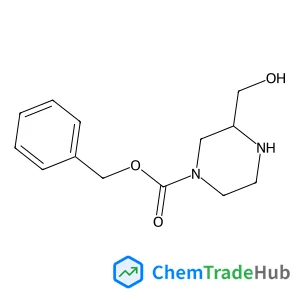
Benzyl 3-(hydroxymethyl)-1-piperazinecarboxylate
CAS Number:
191739-40-9
Molecular Formula:
C13H18N2O3
Recommended Suppliers




Disclaimer
This page provides academic journal information for reference and research purposes only. We are not affiliated with any journal publishers and do not handle publication submissions. For publication-related inquiries, please contact the respective journal publishers directly.
If you notice any inaccuracies in the information displayed, please contact us at support@chemtradehub.com. We will promptly review and address your concerns.