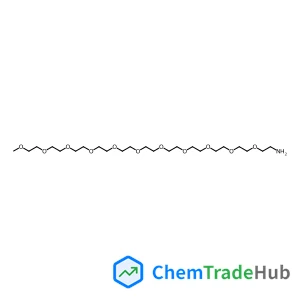
2,5,8,11,14,17,20,23,26,29,32-Undecaoxatetratriacontan-34-amine
CAS Number:
854601-60-8
Molecular Formula:
C23H49NO11
Inclusion complex formation between pyrylium salts 1–6 and β-cyclodextrin (β-CD) was investigated. Because of the positive charge present in the molecule, simple pyrylium salts are hydrophilic and do not show any tendency for encapsulation in β-CD. However, by tuning the hydrophobicity of the substituents present in the 4-position, one can prepare pyrylium salts, which are sufficiently hydrophobic to undergo encapsulation in β-CD cavities. Thus, 2–5 undergo encapsulation as is evident from their NMR and fluorescence spectra in the presence of β-CD. Fluorescence quantum yields of 2–5 were enhanced in the presence of β-CD and these enhancements were used to calculate the association constants by a Benesi–Hildebrand treatment. Electron transfer to the encapsulated pyrylium salts from a water-soluble donor was studied by fluorescence quenching and laser flash photolysis. The pyranyl radicals formed within the β-CD cavity as a result of electron transfer was found to be long-lived and this is attributed to the reduced rate of back electron transfer reaction achieved due to the protection afforded to the radical by the hydrophobic β-CD cavity.
Bruno Pinho, Laura Torrente-Murciano
DOI: 10.1039/C9RE00452A
Jose Ramon Fernandez, Sandra Turrado, Juan Carlos Abanades
DOI: 10.1039/C9RE00361D
Lidia Protasova, Vesna Middelkoop, Nachiketa Ray, Michel Jouve, Alain Bengaouer
DOI: 10.1039/C9RE00092E
Louis Allott, Chris Barnes, Diana Brickute, Sau Fung Jacob Leung, Eric O. Aboagye
DOI: 10.1039/C9RE00226J
Masatsugu Mizuno, Hiroyuki Tateno, Yoshimasa Matsumura, Mahito Atobe
DOI: 10.1039/C7RE00089H
L. D. Elliott, J. P. Knowles, C. S. Stacey, D. J. Klauber, K. I. Booker-Milburn
DOI: 10.1039/C7RE00193B
Eiji Yamaguchi, Nao Taguchi, Akichika Itoh
DOI: 10.1039/C9RE00061E
Jatuporn Salaklang, Veronique Maes, Matthias Conradi, Rudy Dams
DOI: 10.1039/C7RE00120G
R. L. Gomes, C. Crawshaw, L. Neve, R. Lodge, M. Fay, C. Winkler, M. Hull, E. Lester
DOI: 10.1039/C8RE00241J
Xianghong Lü, Hao Li, Xiaohui Du, Xue Wang, Minyi Lan, Jianlin Wu, Jin Zhu, Jianliang Sun, Feng Jiang
DOI: 10.1039/C9RE00347A
3-Fluoro-2-methylbenzylamine is an organic compound with the CAS number 771573-3...
Tert-butyl 2-(oxetan-3-ylidene)acetate is considered safe for its intended uses ...
Proper personal protective equipment (PPE) such as gloves, goggles, and a lab co...
2-Ethyl-4-methyl-1,3-thiazole is commonly synthesized via the reaction of thiour...
This compound should be stored in a cool, dry place away from direct sunlight an...
L-Lysine Acetate Salt (CAS: 52315-92-1) is subject to various regulatory guideli...
6-Fluoro-3-hydroxy-2-pyrazinecarboxamide (CAS: 259793-96-9) is generally conside...
1,1'-Sulfonylbis(1H-imidazole) is a crystalline solid with a molecular weight of...
4-Methyl-7-nitro-1H-indole-3-carbonitrile (CAS: 289483-82-5) is primarily used i...
Waste containing 5-Bromo-3-indolyl-beta-galactoside (CAS: 97753-82-7) should be ...

Physical Chemistry Chemical Physics (PCCP) is an international journal co-owned by 19 physical chemistry and physics societies from around the world. This journal publishes original, cutting-edge research in physical chemistry, chemical physics and biophysical chemistry. To be suitable for publication in PCCP, articles must include significant innovation and/or insight into physical chemistry; this is the most important criterion that reviewers and Editors will judge against when evaluating submissions. The journal has a broad scope and welcomes contributions spanning experiment, theory, computation and data science. Topical coverage includes spectroscopy, dynamics, kinetics, statistical mechanics, thermodynamics, electrochemistry, catalysis, surface science, quantum mechanics, quantum computing and machine learning. Interdisciplinary research areas such as polymers and soft matter, materials, nanoscience, energy, surfaces/interfaces, and biophysical chemistry are welcomed if they demonstrate significant innovation and/or insight into physical chemistry. Joined experimental/theoretical studies are particularly appreciated when complementary and based on up-to-date approaches.
![5-(2-Phenylpyrazolo[1,5-a]pyridin-3-yl)-2H-pyrazolo[3,4-c]pyridazin-3-amine structure](https://static.chemtradehub.com/structs/865/865362-74-9-0091.webp "5-(2-Phenylpyrazolo[1,5-a]pyridin-3-yl)-2H-pyrazolo[3,4-c]pyridazin-3-amine structure")