Compound Q&A
What is Azithromycin EP Impurity H (CAS: 612069-30-4)?
Answer
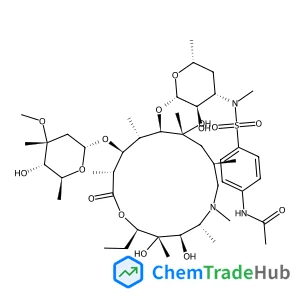
Azithromycin EP Impurity H (CAS: 612069-30-4) is a byproduct found in the pharmaceutical synthesis of azithromycin, an antibiotic used to treat various bacterial infections. It is a semi-synthetic macrolide with a molecular formula of C41H76N2O13.
About
CAS No
612069-30-4
English Name
Azithromycin EP Impurity H (Azithromycin USP Related Compound H)
Molecular Formula
C45H77N3O15S
Molecular Weight
932.18 g/mol
SMILES
CC[C@@H]1[C@@]([C@@H]([C@H](N(C[C@@H](C[C@@]([C@@H]([C@H]([C@@H]([C@H](C(=O)O1)C)O[C@H]2C[C@@]([C@H]([C@@H](O2)C)O)(C)OC)C)O[C@H]3[C@@H]([C@H](C[C@H](O3)C)N(C)S(=O)(=O)c4ccc(cc4)NC(=O)C)O)(C)O)C)C)C)O)(C)O
InChIKey
UXWVLGKGQGGAID-SYARVETMSA-N
Last Updated: 2026-01-03 12:17