Compound Q&A
What are the physical and chemical properties of POLY(VINYLIDENE CHLORIDE-CO-METHYL ACRYLATE) (CAS: 25038-72-6)?
Answer
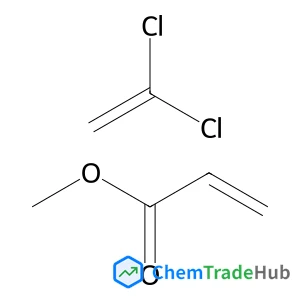
POLY(VINYLIDENE CHLORIDE-CO-METHYL ACRYLATE) (CAS: 25038-72-6) is a semi-crystalline polymer with a high molecular weight. It has poor solubility in common organic solvents but good flexibility. Chemically, it is stable under normal conditions but can react with strong bases and reducing agents. It has a glass transition temperature around 75°C and exhibits excellent barrier properties against gases and water.
About
CAS No
25038-72-6
English Name
POLY(VINYLIDENE CHLORIDE-CO-METHYL ACRYLATE)
Molecular Formula
C6H8Cl2O2
Molecular Weight
183.03 g/mol
SMILES
COC(=O)C=C.C=C(Cl)Cl
InChIKey
WJGVWFOXHWYCHL-UHFFFAOYSA-N
Last Updated: 2025-11-07 19:01