Compound Q&A

Is 7-Methoxyquinolin-3-amine (CAS: 87199-83-5) safe?

Answer
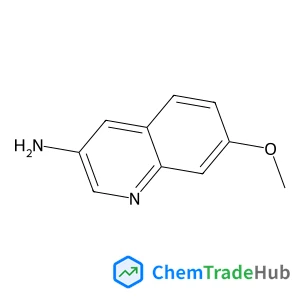
7-Methoxyquinolin-3-amine
7-Methoxyquinolin-3-amine (CAS: 87199-83-5) is generally considered safe for laboratory use, but proper handling and protective measures are necessary. It is important to avoid skin and eye contact, and to use appropriate personal protective equipment (PPE) such as gloves and goggles. Storage in a dry, well-ventilated area is recommended.

About

CAS No 87199-83-5
English Name 7-Methoxyquinolin-3-amine
Molecular Formula C10H10N2O
Molecular Weight 174.20299999999997 g/mol
SMILES COC1=CC2=NC=C(C=C2C=C1)N
InChIKey HKLSFALZGDMVDE-UHFFFAOYSA-N
Last Updated: 2025-10-30 11:43

Related Q&A

Compound Q&A

What is 7-Methoxyquinolin-3-amine (CAS: 87199-83-5)?

7-Methoxyquinolin-3-amine (CAS: 87199-83-5) is a heterocyclic organic compound with a quinoline ring...

Compound Q&A

What are the main uses of 7-Methoxyquinolin-3-amine (CAS: 87199-83-5)?

7-Methoxyquinolin-3-amine (CAS: 87199-83-5) is primarily used in pharmaceutical research for its pot...

Compound Q&A

How should 7-Methoxyquinolin-3-amine (CAS: 87199-83-5) be stored?

7-Methoxyquinolin-3-amine (CAS: 87199-83-5) should be stored in a cool, dry place away from direct s...

Compound Q&A

Are there alternatives to 1-(4-Chlorophenyl)-N-hydroxymethanimine (CAS: 3848-36-0) in synthesis?

When considering alternatives to 1-(4-Chlorophenyl)-N-hydroxymethanimine (CAS: 3...

3848-36-01-(4-Chlorophenyl)-N...
Compound Q&A

How is 3-(4-Bromophenyl)-5-(2-fluorophenyl)-1,2,4-oxadiazole (CAS: 419553-16-5) typically synthesized?

3-(4-Bromophenyl)-5-(2-fluorophenyl)-1,2,4-oxadiazole is synthesized through a m...

419553-16-53-(4-Bromophenyl)-5-...
Compound Q&A

How is 5-Chloro-2-(4-chlorophenyl)-4-methyl-6-[3-(1-piperidinyl)propoxy]pyrimidine (CAS: 1639220-19-1) typically synthesized?

5-Chloro-2-(4-chlorophenyl)-4-methyl-6-[3-(1-piperidinyl)propoxy]pyrimidine (CAS...

1639220-19-15-Chloro-2-(4-chloro...