


Compound Q&A
What is the market or research trend for 2,2,4,4,6,6-Hexamethyl-1,3,5-trithiane?
Answer
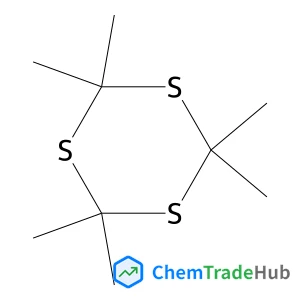
The market for 2,2,4,4,6,6-Hexamethyl-1,3,5-trithiane (CAS: 828-26-2) is driven by its use in the pharmaceutical and polymer industries. Recent research trends focus on its potential as a monomer in polymer synthesis and as an intermediate in the preparation of various organic compounds. Market dynamics are influenced by price fluctuations and increasing demand in the pharmaceutical sector.
About
CAS No
828-26-2
English Name
2,2,4,4,6,6-Hexamethyl-1,3,5-trithiane
Molecular Formula
C9H18S3
Molecular Weight
222.44 g/mol
SMILES
CC1(C)SC(C)(C)SC(C)(C)S1
InChIKey
NBNWHQAWKFYFKI-UHFFFAOYSA-N
Last Updated: 2025-10-05 19:44

