

Compound Q&A

Is Asiaticoside (CAS: 16830-15-2) safe?

Answer
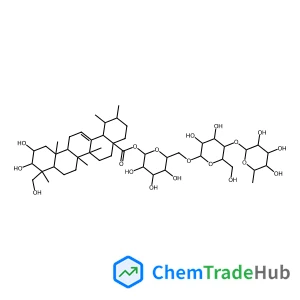
Asiaticoside
Asiaticoside (CAS: 16830-15-2) is generally considered safe when used appropriately. It has low toxicity and is well-tolerated in topical applications. However, proper handling is recommended to avoid inhalation or skin irritation. Safety standards for Asiaticoside are typically aligned with general chemical safety guidelines, ensuring minimal risk when stored and used correctly.

About

CAS No 16830-15-2
English Name Asiaticoside
Molecular Formula C48H78O19
Molecular Weight 959.1215 g/mol
SMILES OCC1OC(OCC2OC(OC(=O)C34CCC(C(C4C4=CCC5C(C4(CC3)C)(C)CCC3C5(C)CC(C(C3(C)CO)O)O)C)C)C(C(C2O)O)O)C(C(C1OC1OC(C)C(C(C1O)O)O)O)O
InChIKey WYQVAPGDARQUBT-UHFFFAOYSA-N
Last Updated: 2025-08-25 01:07

Related Q&A

Compound Q&A

What is Asiaticoside (CAS: 16830-15-2)?

Asiaticoside (CAS: 16830-15-2) is a triterpene glycoside derived from the plant Centella asiatica. I...

Compound Q&A

What are the main uses of Asiaticoside (CAS: 16830-15-2)?

Asiaticoside (CAS: 16830-15-2) is primarily used in skincare products for its wound-healing and anti...

Compound Q&A

How should Asiaticoside (CAS: 16830-15-2) be stored?

Asiaticoside (CAS: 16830-15-2) should be stored in a cool, dry place away from direct light. It is b...

Compound Q&A

Are there alternatives to 1-(4-Chlorophenyl)-N-hydroxymethanimine (CAS: 3848-36-0) in synthesis?

When considering alternatives to 1-(4-Chlorophenyl)-N-hydroxymethanimine (CAS: 3...

3848-36-01-(4-Chlorophenyl)-N...
Compound Q&A

How is 3-(4-Bromophenyl)-5-(2-fluorophenyl)-1,2,4-oxadiazole (CAS: 419553-16-5) typically synthesized?

3-(4-Bromophenyl)-5-(2-fluorophenyl)-1,2,4-oxadiazole is synthesized through a m...

419553-16-53-(4-Bromophenyl)-5-...
Compound Q&A

How is 5-Chloro-2-(4-chlorophenyl)-4-methyl-6-[3-(1-piperidinyl)propoxy]pyrimidine (CAS: 1639220-19-1) typically synthesized?

5-Chloro-2-(4-chlorophenyl)-4-methyl-6-[3-(1-piperidinyl)propoxy]pyrimidine (CAS...

1639220-19-15-Chloro-2-(4-chloro...
