

Compound Q&A

Is 2-(trimethylazaniumyl)acetate (CAS: 107-43-7) safe?

Answer
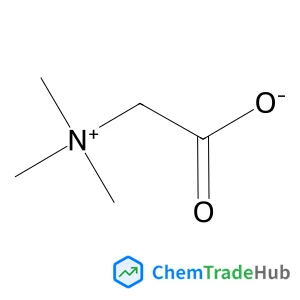
2-(trimethylazaniumyl)acetate
2-(trimethylazaniumyl)acetate (betaine) is generally considered safe when used as directed. It has low toxicity and is approved for use in food and cosmetic products. However, direct contact with concentrated solutions may cause skin or eye irritation. Proper handling and protective measures are recommended to ensure safety in industrial and laboratory environments.

About

CAS No 107-43-7
English Name 2-(trimethylazaniumyl)acetate
Molecular Formula C5H11NO2
Molecular Weight 117.1463 g/mol
SMILES C[N+](C)(C)CC(=O)[O-]
InChIKey KWIUHFFTVRNATP-UHFFFAOYSA-N
Last Updated: 2025-08-25 01:07

Related Q&A

Compound Q&A

What is 2-(trimethylazaniumyl)acetate (CAS: 107-43-7)?

2-(trimethylazaniumyl)acetate, also known as betaine, is a quaternary ammonium compound with the che...

Compound Q&A

What are the main uses of 2-(trimethylazaniumyl)acetate (CAS: 107-43-7)?

2-(trimethylazaniumyl)acetate, or betaine, is widely used in food as a stabilizer and emulsifier. It...

Compound Q&A

How should 2-(trimethylazaniumyl)acetate (CAS: 107-43-7) be stored?

2-(trimethylazaniumyl)acetate should be stored in a cool, dry place, away from direct sunlight. It i...

Compound Q&A

Are there alternatives to 1-(4-Chlorophenyl)-N-hydroxymethanimine (CAS: 3848-36-0) in synthesis?

When considering alternatives to 1-(4-Chlorophenyl)-N-hydroxymethanimine (CAS: 3...

3848-36-01-(4-Chlorophenyl)-N...
Compound Q&A

How is 3-(4-Bromophenyl)-5-(2-fluorophenyl)-1,2,4-oxadiazole (CAS: 419553-16-5) typically synthesized?

3-(4-Bromophenyl)-5-(2-fluorophenyl)-1,2,4-oxadiazole is synthesized through a m...

419553-16-53-(4-Bromophenyl)-5-...
Compound Q&A

How is 5-Chloro-2-(4-chlorophenyl)-4-methyl-6-[3-(1-piperidinyl)propoxy]pyrimidine (CAS: 1639220-19-1) typically synthesized?

5-Chloro-2-(4-chlorophenyl)-4-methyl-6-[3-(1-piperidinyl)propoxy]pyrimidine (CAS...

1639220-19-15-Chloro-2-(4-chloro...