



AD
2-Methyl-4-(trimethylsilyl)-3-butyn-2-ol(CAS: 5272-33-3)
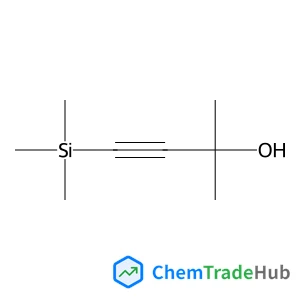
CAS Number
Related Products
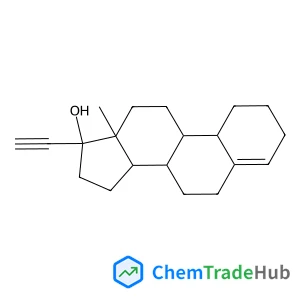
Lynestrenol
CAS Number: 52-76-6
![(8S,13S,14S)-13-Ethyl-7,8,11,12,13,14,15,16-octahydro-1H-cyclopenta[a]phenanthrene-3,17(2H,6H)-dione](https://static.chemtradehub.com/structs/207/20799-05-7-363b.webp)
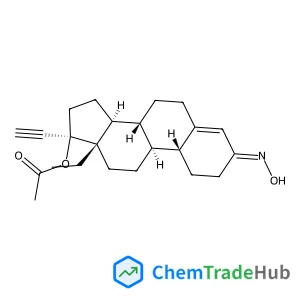
Norgestimate
CAS Number: 35189-28-7
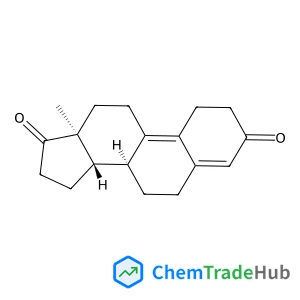
Estra-4,9-diene-3,17-dione
CAS Number: 5173-46-6
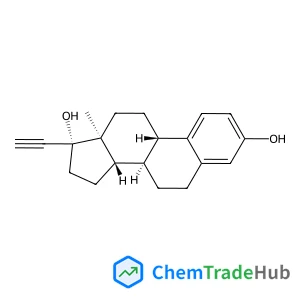
Ethinylestradiol
CAS Number: 57-63-6
![(8S,13S,14S)-13-Methyl-1,4,6,7,8,12,13,14,15,16-decahydrospiro[cyclopenta[a]phenanthrene-3,2'-[1,3]dioxolan]-17(2H)-one](https://static.chemtradehub.com/structs/557/5571-36-8-cafd.webp)
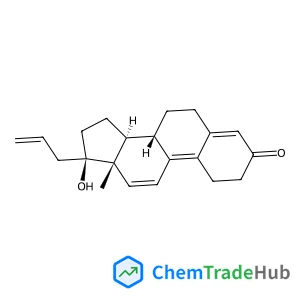
Altrenogest
CAS Number: 850-52-2
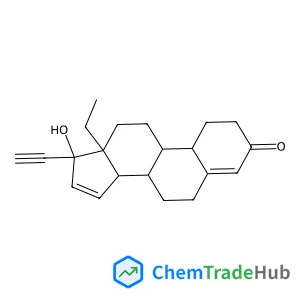
Gestodene
CAS Number: 60282-87-3
Desogestrel
CAS Number: 54024-22-5
Other Suppliers for 2-Methyl-4-(trimethylsilyl)-3-butyn-2-ol





Basic Information
Molecular Formula
C8H16OSi
Molecular Weight
74.12 g/mol
Physical Properties
Melting Point
42.5 ºC
Boiling Point
156 ºC
Flash Point
66.8±19.8 ºC,
Chemical Identifiers
SMILES
CC(C)(C#C[Si](C)(C)C)O
InChIKey
UXOWFNWZWBCLDN-UHFFFAOYSA-N
Database References
MDL Number
MFCD00160794
FAQ
2-Methyl-4-(trimethylsilyl)-3-butyn-2-ol (CAS: 5272-33-3) is a colorless liquid with a molecular weight of approximately 190.32 g/mol. It has a low solubility in water but is soluble in organic solvents. The compound is reactive and can undergo various reactions such as hydrogenation and silylation. It is also unstable under basic conditions and can undergo elimination reactions.
2-Methyl-4-(trimethylsilyl)-3-butyn-2-ol (CAS: 5272-33-3) can be synthesized by the silylation of 2-methyl-3-butyn-2-ol using trimethylsilyl chloride in the presence of a base such as pyridine. The reaction is typically carried out under anhydrous conditions to avoid hydrolysis and dehydration reactions. The yield and selectivity of the reaction can be controlled by the choice of the base and the reaction conditions.
2-Methyl-4-(trimethylsilyl)-3-butyn-2-ol (CAS: 5272-33-3) is primarily used in the pharmaceutical industry for the synthesis of drug intermediates and in the chemical industry for the production of functionalized silanes. It is also used in the polymer industry as a monomer and in the semiconductor industry for the preparation of organosilicon compounds for use in microfabrication processes.
When handling 2-Methyl-4-(trimethylsilyl)-3-butyn-2-ol (CAS: 5272-33-3), proper personal protective equipment (PPE) such as gloves, goggles, and a lab coat should be worn. This compound is reactive and can undergo elimination reactions under basic conditions, so it should be stored in a fume hood and away from sources of heat and moisture. In case of spills, the area should be ventilated and the spill should be cleaned up using appropriate absorbent materials. Always refer to the safety data sheet (SDS) for detailed handling and disposal information.
Safety Notice
Please verify product specifications and safety data before use. Contact the supplier for detailed safety information.
Always follow proper handling procedures
Contact Information
Contact Person
Zhao Zheng, Xu Heng