



AD
1-(2,4-Dihydroxyphenyl)-2-(4-hydroxyphenyl)-1-propanone(CAS: 21255-69-6)
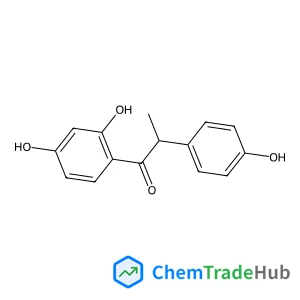
CAS Number
Related Products
![Ethyl 4-(2-{4,5-bis[4-(ethoxycarbonyl)phenyl]-1,3-dithiol-2-ylidene}-5-[4-(ethoxycarbonyl)phenyl]-1,3-dithiol-4-yl)benzoate](https://static.chemtradehub.com/structs/135/1356336-61-2-b5d1.webp)
![1-[(3aS,8aS)-2,2-Dimethyl-4,4,8,8-tetraphenyltetrahydro[1,3]dioxolo[4,5-e][1,3,2]dioxaphosphepin-6-yl]piperidine](https://static.chemtradehub.com/structs/582/582300-11-6-7e49.webp)
![2-[(5-Phenyl-2-pyrimidinyl)amino]ethanol](https://static.chemtradehub.com/structs/298/298217-37-5-72d8.webp)
Other Suppliers for 1-(2,4-Dihydroxyphenyl)-2-(4-hydroxyphenyl)-1-propanone




Basic Information
Molecular Formula
C15H14O4
Molecular Weight
258.27 g/mol
Chemical Identifiers
SMILES
CC(C1=CC=C(C=C1)O)C(=O)C2=C(C=C(C=C2)O)O
InChIKey
JDJPNKPFDDUBFV-UHFFFAOYSA-N
Database References
MDL Number
MFCD00238575
FAQ
1-(2,4-Dihydroxyphenyl)-2-(4-hydroxyphenyl)-1-propanone (CAS: 21255-69-6) falls under the classification of a phenolic compound. It is regulated by the Globally Harmonized System of Classification and Labeling of Chemicals (GHS), which includes labeling requirements for health hazards, flammability, and reactivity. In the European Union, it is covered by REACH regulations, which require detailed documentation of its properties, production volumes, and exposure to humans and the environment. Additionally, the FDA and EPA have specific guidelines for the use and disposal of this compound in pharmaceutical and agricultural applications, including registration and reporting requirements.
While 1-(2,4-Dihydroxyphenyl)-2-(4-hydroxyphenyl)-1-propanone (CAS: 21255-69-6) is a useful intermediate in organic synthesis, there are alternatives that can be considered. For example, 2,4-dihydroxybenzophenone and 4-hydroxyacetophenone are closely related compounds that can serve as substitutes in certain reactions. Other alternatives include using different reagents such as benzil or 2-hydroxy-1-naphthone, which can offer similar functionalities but with different reactivity profiles.
The market and research trends for 1-(2,4-Dihydroxyphenyl)-2-(4-hydroxyphenyl)-1-propanone (CAS: 21255-69-6) are driven by its use in pharmaceuticals, cosmetics, and agrochemicals. Recent studies have focused on its potential as an antifungal and antibacterial agent, as well as its UV absorptive properties. There is also growing interest in its synthesis and applications in green chemistry due to its environmental friendliness. Market trends suggest increasing demand in emerging economies, particularly in Southeast Asia and Latin America, for its use in personal care and pharmaceutical products.
Waste containing 1-(2,4-Dihydroxyphenyl)-2-(4-hydroxyphenyl)-1-propanone (CAS: 21255-69-6) should be collected in appropriate containers and labeled for hazardous waste. It is recommended to handle this waste under controlled conditions to prevent environmental contamination. Disposal methods include incineration or professional waste disposal services that adhere to regulatory standards. For environmental protection, ensure that all disposal methods are in compliance with local and international regulations. Always consult with environmental health and safety officers for specific guidance on waste management and disposal procedures.
Safety Notice
Please verify product specifications and safety data before use. Contact the supplier for detailed safety information.
Always follow proper handling procedures
Contact Information
shenlinxing@macklin.cn
Mobile
15221275939
Telephone
021-50706066
Fax
021-50706099
Visit Website
https://www.macklin.cn