



AD
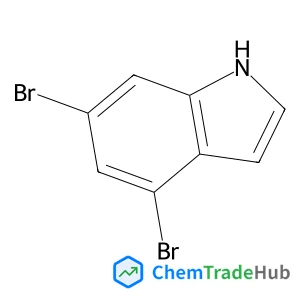
4,6-dibromo-1H-indole(CAS: 99910-50-6)
CAS Number
Related Products
![1-(5-bromo-1H-pyrrolo[2,3-b]pyridin-3-yl)ethanone](https://static.chemtradehub.com/structs/866/866545-96-2-418d.webp)
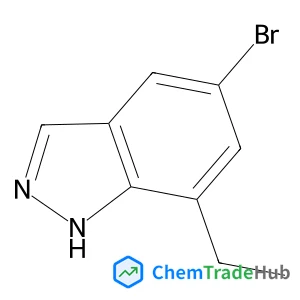
5-Bromo-7-ethyl-1H-indazole
CAS Number: 635712-49-1
![3-Iodo-1H-pyrrolo[3,2-c]pyridine](https://static.chemtradehub.com/structs/877/877060-47-4-eaf5.webp)
3-Iodo-1H-pyrrolo[3,2-c]pyridine
CAS Number: 877060-47-4
![4-Bromo-2-iodo-1-(phenylsulfonyl)-1H-pyrrolo[2,3-B]pyridine](https://static.chemtradehub.com/structs/889/889939-26-8-69e7.webp)
![1H-Pyrrolo[3,2-b]pyridine-5-carboxylic acid](https://static.chemtradehub.com/structs/872/872355-64-1-e3b4.webp)
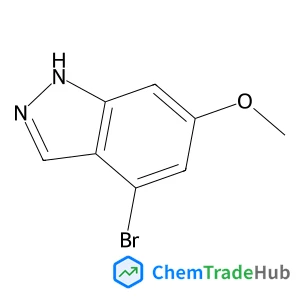
4-Bromo-6-methoxy-1H-indazole
CAS Number: 885520-83-2
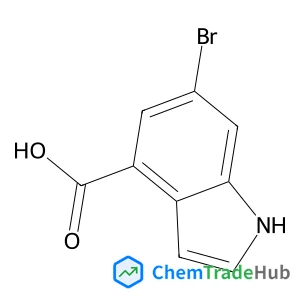
6-Bromo-1H-indole-4-carboxylic acid
CAS Number: 898746-91-3
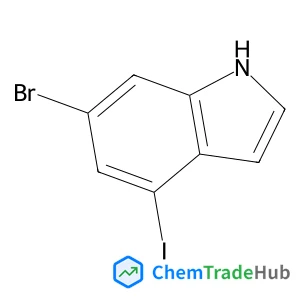
6-Bromo-4-iodo-1H-indole
CAS Number: 885519-17-5
Other Suppliers for 4,6-dibromo-1H-indole







Basic Information
Molecular Formula
C8H5Br2N
Molecular Weight
274.94 g/mol
Physical Properties
Boiling Point
368.526°C at 760 mmHg
Density
2.048
Flash Point
176.678°C
Chemical Identifiers
SMILES
C1=CNC2=C1C(=CC(=C2)Br)Br
InChIKey
PXUDJVIHHHIEGO-UHFFFAOYSA-N
Database References
MDL Number
MFCD07357291
FAQ
4,6-Dibromo-1H-indole (CAS: 99910-50-6) may fall under various regulatory guidelines depending on its intended use. It is classified under the Globally Harmonized System of Classification and Labelling of Chemicals (GHS) as a hazardous substance due to its potential to be toxic. For commercial and industrial use, it is also subject to the REACH regulations in the European Union, which require manufacturers and importers to register substances with the European Chemicals Agency (ECHA). In the United States, the FDA and EPA have specific regulations for the use and handling of chemical substances, including documentation and labeling requirements.
4,6-Dibromo-1H-indole (CAS: 99910-50-6) can be synthesized using various alternative reagents and methods. Some common alternatives include using other substituted indoles or brominated compounds that can serve similar functional groups. For example, 2-bromoindole and 4-bromoindole are often used as precursors. The choice of alternative depends on the specific chemical functionality and properties required for the final product.
The market for 4,6-dibromo-1H-indole (CAS: 99910-50-6) is driven by its use in pharmaceutical and agrochemical industries. Research trends focus on its potential as a precursor for complex organic structures and as a modulator in medicinal chemistry. Recent studies are exploring its role in synthesizing natural products and developing new drug candidates. The demand for this compound is expected to grow with advancements in drug discovery and synthetic chemistry.
Waste containing 4,6-dibromo-1H-indole (CAS: 99910-50-6) should be handled according to the local hazardous waste management regulations. It is important to collect the waste in appropriate containers and ensure proper labeling. For disposal, incineration is a common method, especially if the waste is in a concentrated form. Alternatively, professional waste disposal services can handle the waste safely, ensuring that all environmental protection precautions are taken. Always consult the material safety data sheet (MSDS) and follow local guidelines for waste management.
Safety Notice
Please verify product specifications and safety data before use. Contact the supplier for detailed safety information.
Always follow proper handling procedures
Contact Information
hangbingfang@163.com