



AD
6-(4-amino-2,6-dichlorophenoxy)-4-isopropylpyridazin-3(2H)-one(CAS: 920509-28-0)

CAS Number
Related Products

1-Chloro-6,6-dimethyl-2-hepten-4-yne
CAS Number: 126764-17-8
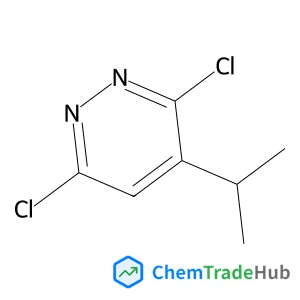
3,6-Dichloro-4-isopropylpyridazine
CAS Number: 107228-51-3

![3-carbamoyl-1-[(2R,3R,4S,5R)-5-[(hydrogen phosphonatooxy)methyl]-3,4-dihydroxyoxolan-2-yl]-1λ?-pyridin-1-ylium](https://static.chemtradehub.com/structs/109/1094-61-7-ae32.webp)
![Diphenylmethyl (6R,7R)-3-hydroxy-8-oxo-7-[(phenylacetyl)amino]-5-thia-1-azabicyclo[4.2.0]oct-2-ene-2-carboxylate](https://static.chemtradehub.com/structs/546/54639-48-4-3019.webp)

2,5-Dimethoxy-2,5-dihydrofuran
CAS Number: 332-77-4
Protamine Sulfate, from Salmon
CAS Number: 9009-65-8


Methylaminolevulinate EP Impurity B HCl
CAS Number: 5451-09-2
Other Suppliers for 6-(4-amino-2,6-dichlorophenoxy)-4-isopropylpyridazin-3(2H)-one





Basic Information
Molecular Formula
C13H13Cl2N3O2
Molecular Weight
314.17 g/mol
Chemical Identifiers
SMILES
CC(C)C1=CC(=NNC1=O)OC2=C(C=C(C=C2Cl)N)Cl
InChIKey
PFQNEKHHAFIRRV-UHFFFAOYSA-N
Database References
FAQ
6-(4-amino-2,6-dichlorophenoxy)-4-isopropylpyridazin-3(2H)-one is a crystalline compound with a molecular weight of approximately 399.9 g/mol. It has a low solubility in water but good solubility in organic solvents like dimethylformamide (DMF). The compound is reactive towards nucleophiles and can undergo substitution reactions. It is stable under standard storage conditions but is sensitive to moisture and air oxidation.
6-(4-amino-2,6-dichlorophenoxy)-4-isopropylpyridazin-3(2H)-one is typically synthesized via a multi-step process involving chlorination, amination, and isopropylation. Commonly, the reaction is conducted in a polar aprotic solvent like acetonitrile. The yield is around 70-80%, with good selectivity towards the desired product. Catalysts such as potassium carbonate are often used to enhance the reaction efficiency.
6-(4-amino-2,6-dichlorophenoxy)-4-isopropylpyridazin-3(2H)-one is primarily used in the pharmaceutical industry for the development of novel drugs. It is also utilized in the polymer industry for the modification of polymer properties and in the sensor industry for developing chemical sensors. Additionally, it has potential applications in the semiconductor industry due to its electronic properties.
When handling 6-(4-amino-2,6-dichlorophenoxy)-4-isopropylpyridazin-3(2H)-one, it is essential to wear appropriate personal protective equipment (PPE) such as gloves, goggles, and a lab coat. Work should be conducted in a fume hood due to its potential to release toxic vapors. Spills should be cleaned up immediately using appropriate absorbent materials. Always refer to the Safety Data Sheet (SDS) for detailed handling and emergency procedures. The compound is stable under controlled conditions but should be stored in a dry, cool place, away from moisture and oxidizing agents.
Safety Notice
Please verify product specifications and safety data before use. Contact the supplier for detailed safety information.
Always follow proper handling procedures
Contact Information
Contact Person
Manager Zhao
439706954@qq.com