



AD
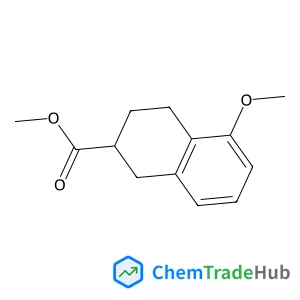
methyl 5-methoxy-1,2,3,4-tetrahydronaphthalene-2-carboxylate(CAS: 83781-71-9)
CAS Number
Related Products

methyl}benzamide](https://static.chemtradehub.com/structs/224/2247491-97-8-c197.webp)
![4-Amino-2-({[(2-methyl-2-propanyl)oxy]carbonyl}amino)butanoic acid](https://static.chemtradehub.com/structs/289/2899-79-8-863a.webp)
![2-Methyl-2-propanyl 7-(4,4,5,5-tetramethyl-1,3,2-dioxaborolan-2-yl)-2-azaspiro[4.4]nonane-2-carboxylate](https://static.chemtradehub.com/structs/230/2304631-27-2-21b7.webp)
![Methyl 3-(4-{3-[3-(trifluoromethyl)phenyl]-1H-pyrazol-5-yl}-1-piperidinyl)propanoate](https://static.chemtradehub.com/structs/103/1030386-15-2-7851.webp)
Other Suppliers for methyl 5-methoxy-1,2,3,4-tetrahydronaphthalene-2-carboxylate







Basic Information
Molecular Formula
C13H16O3
Molecular Weight
220.27 g/mol
Chemical Identifiers
SMILES
COC(=O)C1CCC2=C(C1)C=CC=C2OC
InChIKey
LPVPIHAVUIQSCD-UHFFFAOYSA-N
Database References
MDL Number
MFCD21363135
FAQ
Methyl 5-methoxy-1,2,3,4-tetrahydronaphthalene-2-carboxylate (CAS: 83781-71-9) falls under various regulatory frameworks. It is classified as a hazardous substance under the Globally Harmonized System of Classification and Labelling of Chemicals (GHS), which includes physical hazards and health risks. It is also subject to the Registration, Evaluation, Authorisation and Restriction of Chemicals (REACH) regulation in the EU. In the US, it is regulated by the Environmental Protection Agency (EPA) and the Food and Drug Administration (FDA) for environmental and safety standards.
Are there alternatives to methyl 5-methoxy-1,2,3,4-tetrahydronaphthalene-2-carboxylate in synthesis?
Alternative reagents for synthesizing similar compounds include methyl 5-hydroxy-1,2,3,4-tetrahydronaphthalene-2-carboxylate and methyl 5-ethoxy-1,2,3,4-tetrahydronaphthalene-2-carboxylate. These compounds offer similar chemical functionalities and can be used as substitutes in various synthetic routes. It is important to consider the specific requirements and constraints of the synthesis when choosing an alternative.
The market for methyl 5-methoxy-1,2,3,4-tetrahydronaphthalene-2-carboxylate is growing due to its applications in pharmaceuticals and as a precursor in organic synthesis. Research trends are focusing on its use in drug development and as a component in new materials. The demand is expected to increase with advancements in these fields, though the exact trends can vary based on global economic factors and new discoveries.
Waste containing methyl 5-methoxy-1,2,3,4-tetrahydronaphthalene-2-carboxylate should be managed according to local regulations. Typically, it should be collected in appropriate containers, labeled as hazardous, and disposed of through a professional waste disposal service. Incineration is a common method, but it must be done in compliance with environmental protection regulations to minimize environmental impact. Safe storage and transportation are also critical to prevent contamination and ensure worker safety.
Safety Notice
Please verify product specifications and safety data before use. Contact the supplier for detailed safety information.
Always follow proper handling procedures
Contact Information
Contact Person
Manager Gu
sales@gh-reagent.com
Mobile
18939883912
Telephone
021-34536277
Visit Website
https://www.gh-reagent.com/Address
No. 91, Building 2, Block 537, Sanada Road, Minhang District, Pujiang Town, Shanghai