



AD
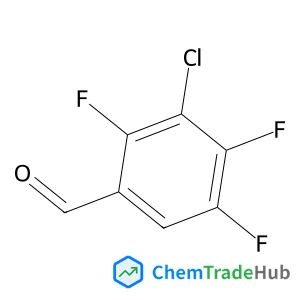
3-Chloro-2,4,5-trifluorobenzaldehyde(CAS: 101513-80-8)
CAS Number
Related Products

![Ethyl 4-(2-{4,5-bis[4-(ethoxycarbonyl)phenyl]-1,3-dithiol-2-ylidene}-5-[4-(ethoxycarbonyl)phenyl]-1,3-dithiol-4-yl)benzoate](https://static.chemtradehub.com/structs/135/1356336-61-2-b5d1.webp)
![1-[(3aS,8aS)-2,2-Dimethyl-4,4,8,8-tetraphenyltetrahydro[1,3]dioxolo[4,5-e][1,3,2]dioxaphosphepin-6-yl]piperidine](https://static.chemtradehub.com/structs/582/582300-11-6-7e49.webp)
![2-[(5-Phenyl-2-pyrimidinyl)amino]ethanol](https://static.chemtradehub.com/structs/298/298217-37-5-72d8.webp)





Other Suppliers for 3-Chloro-2,4,5-trifluorobenzaldehyde





Basic Information
Molecular Formula
C7H2ClF3O
Molecular Weight
194.54 g/mol
Chemical Identifiers
SMILES
C1=C(C(=C(C(=C1F)F)Cl)F)C=O
InChIKey
FNOTUPISSVMOCU-UHFFFAOYSA-N
Database References
MDL Number
MFCD04972744
FAQ
3-Chloro-2,4,5-trifluorobenzaldehyde (CAS: 101513-80-8) falls under multiple regulatory frameworks. It is classified under the Globally Harmonized System of Classification and Labelling of Chemicals (GHS) as a Category 2 skin corrosion/irritation and Category 2 serious eye damage/eye irritation. Manufacturers and importers must comply with REACH regulations, ensuring that the substance is registered and satisfies the necessary safety data. Additionally, the FDA and EPA regulate its use and disposal in the United States, requiring proper handling and documentation to prevent environmental contamination.
Various alternatives can be used in the synthesis of 3-Chloro-2,4,5-trifluorobenzaldehyde (CAS: 101513-80-8). Common substitutes include 3-Fluoro-2,4,5-trifluorobenzaldehyde and 3-Bromo-2,4,5-trifluorobenzaldehyde. These alternatives offer similar reactivity but differ in functional groups. Other options include using different starting materials such as 2,4,5-trifluorophenyl methanol or similar compounds, which can be converted to the desired aldehyde through various oxidation processes.
The market for 3-Chloro-2,4,5-trifluorobenzaldehyde (CAS: 101513-80-8) is currently stable, with a growing interest in its application in pharmaceuticals and agrochemicals. Research trends indicate an increasing focus on its role as a key intermediate for synthesizing complex organic compounds. Its unique electronic properties make it particularly valuable in the development of new drugs and pesticides. However, due to its specific reactivity and environmental concerns, there is a trend towards exploring more sustainable alternatives and optimizing synthesis methods.
Waste containing 3-Chloro-2,4,5-trifluorobenzaldehyde (CAS: 101513-80-8) should be handled with caution to prevent environmental contamination. Collection should be done in approved containers and stored in a secure area. Incineration is a common disposal method, but it must be conducted in an appropriately equipped facility to avoid the release of harmful chlorinated compounds. Alternatively, professional waste disposal services can be used to handle the waste safely. Proper documentation and compliance with local environmental regulations are essential to ensure the safe disposal of this compound.
Safety Notice
Please verify product specifications and safety data before use. Contact the supplier for detailed safety information.
Always follow proper handling procedures
Contact Information
shenlinxing@macklin.cn
Mobile
15221275939
Telephone
021-50706066
Fax
021-50706099
Visit Website
https://www.macklin.cn