



AD
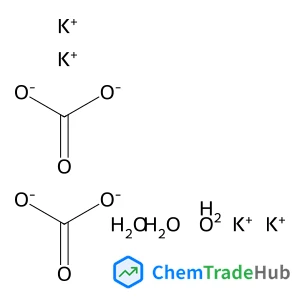
Carbonic acid, dipotassium salt, hydrate (2:3)(CAS: 6381-79-9)
CAS Number
Related Products
methyl}benzamide](https://static.chemtradehub.com/structs/224/2247491-97-8-c197.webp)
![4-Amino-2-({[(2-methyl-2-propanyl)oxy]carbonyl}amino)butanoic acid](https://static.chemtradehub.com/structs/289/2899-79-8-863a.webp)
![2-Methyl-2-propanyl 7-(4,4,5,5-tetramethyl-1,3,2-dioxaborolan-2-yl)-2-azaspiro[4.4]nonane-2-carboxylate](https://static.chemtradehub.com/structs/230/2304631-27-2-21b7.webp)
![Methyl 3-(4-{3-[3-(trifluoromethyl)phenyl]-1H-pyrazol-5-yl}-1-piperidinyl)propanoate](https://static.chemtradehub.com/structs/103/1030386-15-2-7851.webp)
Other Suppliers for Carbonic acid, dipotassium salt, hydrate (2:3)



Basic Information
Molecular Formula
C2H6K4O9
Molecular Weight
330.46 g/mol
EINECS
678-913-4
Physical Properties
Melting Point
891 °C
Density
2.043
Water Solubility
Soluble in water. Practically insoluble in alcohol
Chemical Identifiers
SMILES
[O-]C(=O)[O-].[O-]C(=O)[O-].O.O.O.[K+].[K+].[K+].[K+]
InChIKey
WWVGGBSGYNQKCY-UHFFFAOYSA-J
Database References
MDL Number
MFCD00149925
FAQ
Carbonic acid, dipotassium salt, hydrate (2:3) is a white crystalline solid with a molecular weight of approximately 234.23 g/mol. It is slightly soluble in water. Chemically, it is stable under normal conditions but can react with acids to release carbon dioxide. It has a hydrate form, meaning it retains a certain amount of water in its crystal lattice.
Carbonic acid, dipotassium salt, hydrate (2:3) is synthesized by the reaction of potassium carbonate with carbon dioxide in an aqueous solution. The process involves the formation of potassium hydrogen carbonate, which then reacts with additional potassium carbonate to form the dipotassium salt. The reaction is typically conducted at room temperature and involves careful control of pH and temperature to achieve high yield and selectivity.
Carbonic acid, dipotassium salt, hydrate (2:3) is primarily used in the pharmaceutical industry as a buffer and stabilizer in drug formulations. It also finds applications in the food industry as a pH adjuster and in the polymer industry for the synthesis of certain polymers. Additionally, it is used in the production of sensors and in some semiconductor processes.
When handling Carbonic acid, dipotassium salt, hydrate (2:3) (CAS: 6381-79-9), it is important to use personal protective equipment (PPE) such as gloves and goggles. It should be stored in a cool, dry place away from direct sunlight. Fume hoods should be used when performing operations that may release dust or vapors. In case of a spill, it should be cleaned up carefully using appropriate spill kits, and the area should be well ventilated. Always consult the Safety Data Sheet (SDS) for detailed handling and disposal instructions.
Safety Notice
Please verify product specifications and safety data before use. Contact the supplier for detailed safety information.
Always follow proper handling procedures
Contact Information
Contact Person
Manager Gu
sales@gh-reagent.com
Mobile
18939883912
Telephone
021-34536277
Visit Website
https://www.gh-reagent.com/Address
No. 91, Building 2, Block 537, Sanada Road, Minhang District, Pujiang Town, Shanghai