



AD
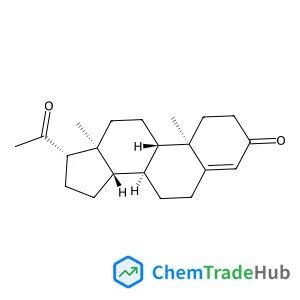
Pregn-4-ene-3,20-dione(CAS: 57-83-0)
CAS Number
Related Products
![(4aS,4bS,6aS,7S,9aS,9bR,11aS)-7-Hydroxy-4a,6a,7-trimethyltetradecahydroindeno[4,5-h]isochromen-2(1H)-one](https://static.chemtradehub.com/structs/53-/53-39-4-4df8.webp)

![1-(3-Chlorophenyl)-2-[(2-methyl-2-propanyl)amino]-1-propanone](https://static.chemtradehub.com/structs/349/34911-55-2-409d.webp)

Other Suppliers for Pregn-4-ene-3,20-dione



Basic Information
Molecular Formula
C21H30O2
Molecular Weight
314.47 g/mol
Physical State
Powder
Physical Properties
Melting Point
128-132 °C (lit.)
Boiling Point
394.13°C (rough estimate)
Flash Point
2℃(35.6℉)(lit.)
Water Solubility
<0.1 g/100 mL at 19 ºC
Chemical Identifiers
SMILES
CC(=O)[C@H]1CC[C@@H]2[C@@]1(CC[C@H]3[C@H]2CCC4=CC(=O)CC[C@]34C)C
InChIKey
RJKFOVLPORLFTN-LEKSSAKUSA-N
Database References
MDL Number
MFCD00003658
Beilstein Registry Number
1915950
FAQ
Pregn-4-ene-3,20-dione (CAS: 57-83-0) is a steroid compound with the chemical formula C21H30O2. It serves as a key intermediate in steroid hormone biosynthesis, featuring a pregnane ring system and two ketone groups. This compound is typically a white crystalline solid with low solubility in water. Its structural simplicity makes it valuable for research and industrial applications, while its reactivity influences its role in biochemical pathways and synthetic chemistry.
Pregn-4-ene-3,20-dione (CAS: 57-83-0) is primarily used in pharmaceuticals as a precursor for corticosteroids and other steroid-derived drugs. In research, it aids in studying hormone metabolism and synthetic pathways. Industrially, it serves as a chemical intermediate for producing pharmaceuticals and cosmetics. Its applications also extend to veterinary medicine and as a reference standard in analytical chemistry, highlighting its versatility in various sectors.
Pregn-4-ene-3,20-dione (CAS: 57-83-0) is generally safe when handled properly, but it requires caution due to potential irritant properties. Safety standards emphasize avoiding skin contact and inhalation, with protective measures like gloves and ventilation recommended. While not classified as highly toxic, long-term exposure or ingestion should be avoided. Always follow OSHA guidelines and proper lab safety protocols for safe handling and disposal.
Pregn-4-ene-3,20-dione (CAS: 57-83-0) should be stored in a cool, dry place (2-8°C), away from light and moisture. Use sealed, airtight containers to maintain stability and prevent degradation. Avoid exposure to air or reactive substances to ensure long-term preservation. Proper storage conditions are critical to maintaining its chemical integrity and safety, particularly in industrial and research settings.
Safety Notice
Please verify product specifications and safety data before use. Contact the supplier for detailed safety information.
Always follow proper handling procedures