



AD
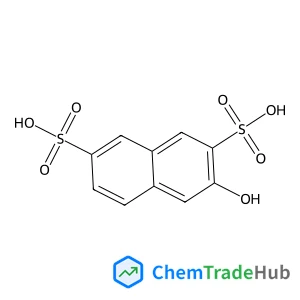
3-Hydroxy-2,7-naphthalenedisulfonic acid(CAS: 148-75-4)
CAS Number
Related Products
methyl}benzamide](https://static.chemtradehub.com/structs/224/2247491-97-8-c197.webp)
![4-Amino-2-({[(2-methyl-2-propanyl)oxy]carbonyl}amino)butanoic acid](https://static.chemtradehub.com/structs/289/2899-79-8-863a.webp)
![2-Methyl-2-propanyl 7-(4,4,5,5-tetramethyl-1,3,2-dioxaborolan-2-yl)-2-azaspiro[4.4]nonane-2-carboxylate](https://static.chemtradehub.com/structs/230/2304631-27-2-21b7.webp)
![Methyl 3-(4-{3-[3-(trifluoromethyl)phenyl]-1H-pyrazol-5-yl}-1-piperidinyl)propanoate](https://static.chemtradehub.com/structs/103/1030386-15-2-7851.webp)
Other Suppliers for 3-Hydroxy-2,7-naphthalenedisulfonic acid






Basic Information
Molecular Formula
C10H8O7S2
Molecular Weight
304.3 g/mol
Physical Properties
Boiling Point
415.13°C (rough estimate)
Flash Point
°Cat760mmHg
Chemical Identifiers
SMILES
C1=CC(=CC2=CC(=C(C=C21)O)S(=O)(=O)O)S(=O)(=O)O
InChIKey
USWINTIHFQKJTR-UHFFFAOYSA-N
Database References
MDL Number
MFCD00035732
FAQ
3-Hydroxy-2,7-naphthalenedisulfonic acid (CAS: 148-75-4) is subject to regulation under various guidelines including GHS for chemical classification and label requirements. It is also covered by REACH regulations in the EU for registration, evaluation, authorization, and restriction of chemicals. Additionally, FDA and EPA guidelines apply for use in food, pharmaceuticals, and environmental handling, ensuring safety and compliance with national and international standards.
While 3-Hydroxy-2,7-naphthalenedisulfonic acid (CAS: 148-75-4) is a versatile compound, alternatives such as other naphthalenedisulfonic acids or their derivatives can be used in synthesis, depending on specific applications. Common substitutes include 1,5-naphthalenedisulfonic acid or 2,6-naphthalenedisulfonic acid, offering similar functionalities but with different properties and reactivity.
The market for 3-Hydroxy-2,7-naphthalenedisulfonic acid (CAS: 148-75-4) is growing due to its applications in dyeing, pH indicators, and analytical reagents. Research trends are focusing on its use in environmental monitoring and as a component in advanced materials. The market is also seeing increasing demand in the pharmaceutical industry for its potential in drug development and diagnostic assays, driven by technological advancements and regulatory support.
Waste containing 3-Hydroxy-2,7-naphthalenedisulfonic acid (CAS: 148-75-4) should be collected in appropriate containers and stored in a secure, well-ventilated area. Prior to disposal, neutralize the waste with appropriate chemicals to mitigate environmental impact. For large quantities, professional waste disposal services should be utilized. Incineration is a common method for disposal, but ensure compliance with local regulations to avoid environmental contamination. Always follow safety guidelines and local environmental protection laws when handling and disposing of this compound.
Safety Notice
Please verify product specifications and safety data before use. Contact the supplier for detailed safety information.
Always follow proper handling procedures
Contact Information
Contact Person
Manager Gu
sales@gh-reagent.com
Mobile
18939883912
Telephone
021-34536277
Visit Website
https://www.gh-reagent.com/Address
No. 91, Building 2, Block 537, Sanada Road, Minhang District, Pujiang Town, Shanghai