



AD
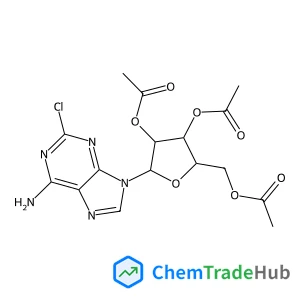
2-Chloro-6-amino-9-(2’,3’,5’-tri-O-acetyl-b-D-ribofuranosyl)purine(CAS: 79999-39-6)
CAS Number
Related Products
![2-[(6-Methoxy-1H-benzimidazol-2-yl)methyl]-3,5-dimethyl-4(1H)-pyridinone](https://static.chemtradehub.com/structs/138/1384163-92-1-9a16.webp)
![N-[(2'-Cyano-4-biphenylyl)methyl]-N-pentanoyl-L-valine](https://static.chemtradehub.com/structs/443/443093-86-5-91f8.webp)
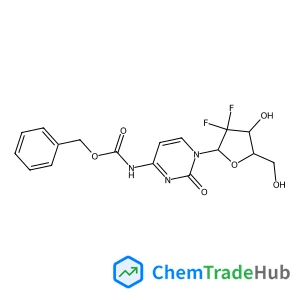
N-Carboxybenzyl Gemcitabine
CAS Number: 138685-83-3
![3-(6-Chloro-5-fluoropyrimidin-4-YL)-2-(2,4-difluorophenyl)-1-[1,2,4]triazol-1-YL-butan-2-OL](https://static.chemtradehub.com/structs/137/137234-75-4-eadc.webp)
![1-[[(2E)-3-Phenyl-2-propen-1-yl]oxy]naphthalene](https://static.chemtradehub.com/structs/109/1091626-77-5-7310.webp)
![5-[(2S)-2-{[2-(2-Ethoxyphenoxy)ethyl]amino}propyl]-2-methoxybenzenesulfonamide](https://static.chemtradehub.com/structs/106/106138-88-9-ea21.webp)
Other Suppliers for 2-Chloro-6-amino-9-(2’,3’,5’-tri-O-acetyl-b-D-ribofuranosyl)purine



Basic Information
Molecular Formula
C16H18ClN5O7
Molecular Weight
427.8 g/mol
Physical Properties
Melting Point
67-75°C
Density
1.70±0.1 g/cm3 (20 ºC 760 Torr),
Chemical Identifiers
SMILES
CC(=O)OCC1C(C(C(O1)N2C=NC3=C(N=C(N=C32)Cl)N)OC(=O)C)OC(=O)C
InChIKey
IMTFOTCIQPKKSP-UHFFFAOYSA-N
Database References
MDL Number
MFCD09953421
FAQ
2-Chloro-6-amino-9-(2’,3’,5’-tri-O-acetyl-b-D-ribofuranosyl)purine is a crystalline compound with a high molecular weight. It has a low water solubility and moderate solubility in organic solvents. It is chemically reactive, particularly towards nucleophilic substitution reactions. Its reactivity can be influenced by the acetyl groups, which can protect the ribose moiety from hydrolytic cleavage. Additionally, it is susceptible to base-catalyzed deacetylation under basic conditions.
2-Chloro-6-amino-9-(2’,3’,5’-tri-O-acetyl-b-D-ribofuranosyl)purine is commonly synthesized through a multi-step process involving the acetylation of the ribose moiety followed by the installation of the purine ring and the chloro and amino functionalities. Catalytic conditions often involve the use of mild acid or base catalysts, and the reaction typically proceeds with high selectivity and yield.
2-Chloro-6-amino-9-(2’,3’,5’-tri-O-acetyl-b-D-ribofuranosyl)purine is primarily used in the pharmaceutical industry for the development of nucleoside analogues. It may also find applications in the field of polymer science for the synthesis of customized biopolymers and in the development of novel sensors and semiconductors.
When handling 2-Chloro-6-amino-9-(2’,3’,5’-tri-O-acetyl-b-D-ribofuranosyl)purine, it is essential to use personal protective equipment (PPE) such as gloves, goggles, and a lab coat. Work must be conducted in a well-ventilated area or a fume hood to minimize exposure to airborne particles. Spills should be cleaned up using appropriate absorbents, and the material safety data sheet (MSDS) should be consulted for specific handling guidelines and emergency procedures.
Safety Notice
Please verify product specifications and safety data before use. Contact the supplier for detailed safety information.
Always follow proper handling procedures
Contact Information
Contact Person
Wang Manager
3008058303@qq.com