



AD
Tubeimoside III(CAS: 115810-13-4)
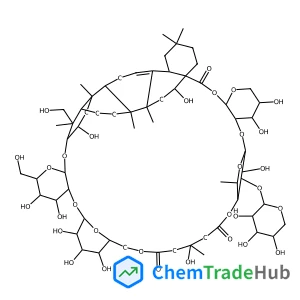
CAS Number
Related Products

Quillaic acid
CAS Number: 631-01-6

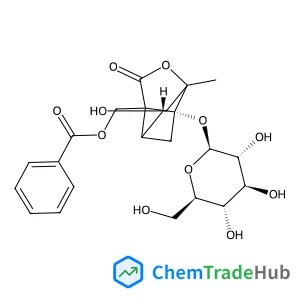
Albiflorin
CAS Number: 39011-90-0



Ganoderic acid C6
CAS Number: 105742-76-5
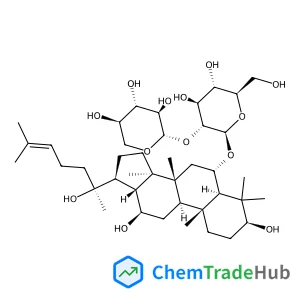

Ingenol
CAS Number: 30220-46-3
![(3S)-5-Hydroxy-2,2,8-trimethyl-6-oxo-3,4-dihydro-2H,6H-pyrano[3,2-g]chromen-3-yl beta-D-glucopyranoside](https://static.chemtradehub.com/structs/806/80681-44-3-05c5.webp)
Other Suppliers for Tubeimoside III



Basic Information
Molecular Formula
C64H100O31
Molecular Weight
1365.5 g/mol
Physical State
Powder
Chemical Identifiers
SMILES
CC1C2C(C(C(O1)OC3C(C(COC3OC(=O)C45CCC(CC4C6=CCC7C(C6(CC5O)C)(CCC8C7(CC(C(C8(C)CO)OC9C(C(C(C(O9)CO)O)O)OC1C(C(C(C(O1)COC(=O)CC(CC(=O)O2)(C)O)O)O)O)O)C)C)(C)C)O)O)O)OC1C(C(C(CO1)O)O)O
InChIKey
MTICHQXHYUJVDV-UHFFFAOYSA-N
Database References
MDL Number
MFCD22586602
FAQ
Tubeimoside III (CAS: 115810-13-4) falls under the purview of the Globally Harmonized System of Classification and Labeling of Chemicals (GHS) for classification based on its physical and chemical properties. In the European Union, it is regulated under the Registration, Evaluation, Authorization and Restriction of Chemicals (REACH) regulation. For the United States, the Environmental Protection Agency (EPA) and the Food and Drug Administration (FDA) have specific requirements for handling and use. Regulatory guidelines include safety data sheets (SDS), proper labeling, and the need for risk assessments prior to manufacture and use.
There are several alternatives to Tubeimoside III (CAS: 115810-13-4) in synthesis, including similar triterpene compounds and their analogs. These alternatives can offer comparable biological activities and are often synthesized using different starting materials or reaction pathways. Common alternative reagents include saponins, sterols, and other triterpenoids, which can be used as substitutes depending on the specific application and desired outcome.
Tubeimoside III (CAS: 115810-13-4) has gained interest in recent research due to its potential biological activities, particularly in cancer therapy. Market trends indicate increasing demand for its use in pharmaceutical and biotechnology applications. Research is focusing on understanding its mechanism of action, optimizing synthesis techniques, and exploring its therapeutic potential. The trend suggests a growing focus on natural products and their derivatives in drug development.
Waste containing Tubeimoside III (CAS: 115810-13-4) should be collected in appropriate containers and labeled with the relevant hazard information. Disposal methods include incineration, which is a common practice for organic waste. Alternatively, professional waste disposal services can be utilized to ensure compliance with local regulations. Environmental protection measures include minimizing the release of waste into the environment and ensuring that all disposal activities are conducted in accordance with regulatory requirements. Proper training and safety protocols should be followed to prevent any hazards during handling and disposal.
Safety Notice
Please verify product specifications and safety data before use. Contact the supplier for detailed safety information.
Always follow proper handling procedures

Contact Information
Contact Person
Yang Xueri
2916345763@qq.com
Mobile
13980723364
Telephone
028-61983833
Visit Website
http://www.nakeli-biotech.com/Address
No. 1127, Unit 2, Floor 11, Building 3, Dikang Avenue 8, High-tech Zone, Chengdu