



AD
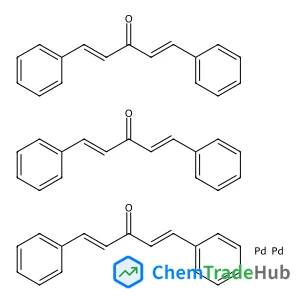
Tris(dibenzylideneacetone)dipalladium(0)(CAS: 52409-22-0)
CAS Number
Related Products
![2-Chloro-10-[3-(4-methyl-1-piperazinyl)propyl]-10H-phenothiazine](https://static.chemtradehub.com/structs/58-/58-38-8-9a44.webp)
![(2S)-2-Amino-4-[(2-methyl-2-propanyl)oxy]-4-oxobutanoic acid](https://static.chemtradehub.com/structs/305/3057-74-7-60dc.webp)

Ethyl 2-acetylbenzoate
CAS Number: 103935-10-0


Butanoic acid, 2-methyl-, butyl ester
CAS Number: 15706-73-7

6,10-Dimethyl-5,9-undecadien-2-one
CAS Number: 689-67-8

Sodium chloride
CAS Number: 7647-14-5
Other Suppliers for Tris(dibenzylideneacetone)dipalladium(0)




Basic Information
Molecular Formula
C51H42O3Pd2
Molecular Weight
573 g/mol
Physical Properties
Melting Point
152-155 °C(lit.)
Density
1.1000
Chemical Identifiers
SMILES
C1=CC=C(C=C1)C=CC(=O)C=CC2=CC=CC=C2.C1=CC=C(C=C1)C=CC(=O)C=CC2=CC=CC=C2.C1=CC=C(C=C1)C=CC(=O)C=CC2=CC=CC=C2.[Pd].[Pd]
InChIKey
JDNKGQQQEFTALK-UHFFFAOYSA-N
Database References
MDL Number
MFCD00013310
FAQ
Tris(dibenzylideneacetone)dipalladium(0) (CAS: 52409-22-0) is subject to regulatory guidelines under the Globally Harmonized System of Classification and Labeling of Chemicals (GHS) for hazardous chemicals. It must comply with REACH (Registration, Evaluation, Authorization and Restriction of Chemicals) regulations in the European Union. In the United States, it is also regulated by the Occupational Safety and Health Administration (OSHA) and the Environmental Protection Agency (EPA) for workplace and environmental safety.
There are alternative palladium complexes that can be used in place of Tris(dibenzylideneacetone)dipalladium(0) (CAS: 52409-22-0), such as dichlorobis(1,5-cyclooctadiene)palladium(II) and bis(dibenzylideneacetone)palladium. These alternatives offer similar catalytic properties but may have different reactivity profiles, solubility, and stability. The choice of alternative depends on the specific reaction conditions and desired outcome.
What is the market or research trend for Tris(dibenzylideneacetone)dipalladium(0) (CAS: 52409-22-0)?
The market for Tris(dibenzylideneacetone)dipalladium(0) (CAS: 52409-22-0) is driven by its use in organometallic chemistry and catalytic reactions. Research trends indicate an increasing focus on sustainable and eco-friendly catalysts. There is a growing interest in exploring the use of this compound in green chemistry, particularly in the synthesis of chiral molecules and pharmaceuticals. Additionally, studies are being conducted to understand its potential in new catalytic systems and to improve its efficiency and selectivity.
Waste containing Tris(dibenzylideneacetone)dipalladium(0) (CAS: 52409-22-0) should be collected in sealed containers and stored away from incompatible materials. For disposal, it is recommended to use professional waste disposal services that specialize in handling hazardous waste. Incineration is a common method for disposal, provided it is conducted in an incinerator designed for hazardous substances. Environmental protection measures include proper labeling, ventilation in handling areas, and adherence to local and national waste management regulations.
Safety Notice
Please verify product specifications and safety data before use. Contact the supplier for detailed safety information.
Always follow proper handling procedures
Contact Information
Contact Person
Hu Gebing
2369399482@qq.com