



AD
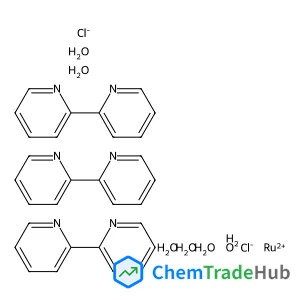
Tris(2,2-bipyridyl)ruthenium(II) Chloridehexahydrate(CAS: 50525-27-4)
CAS Number
Related Products



methyl}benzamide](https://static.chemtradehub.com/structs/224/2247491-97-8-c197.webp)
![4-Amino-2-({[(2-methyl-2-propanyl)oxy]carbonyl}amino)butanoic acid](https://static.chemtradehub.com/structs/289/2899-79-8-863a.webp)
![2-Methyl-2-propanyl 7-(4,4,5,5-tetramethyl-1,3,2-dioxaborolan-2-yl)-2-azaspiro[4.4]nonane-2-carboxylate](https://static.chemtradehub.com/structs/230/2304631-27-2-21b7.webp)
![Methyl 3-(4-{3-[3-(trifluoromethyl)phenyl]-1H-pyrazol-5-yl}-1-piperidinyl)propanoate](https://static.chemtradehub.com/structs/103/1030386-15-2-7851.webp)

Other Suppliers for Tris(2,2-bipyridyl)ruthenium(II) Chloridehexahydrate




Basic Information
Molecular Formula
C30H36Cl2N6O6Ru
Molecular Weight
748.6 g/mol
Physical Properties
Melting Point
>300 °C (lit.)
Flash Point
107.2℃
Water Solubility
Soluble in water.
Chemical Identifiers
SMILES
C1=CC=NC(=C1)C2=CC=CC=N2.C1=CC=NC(=C1)C2=CC=CC=N2.C1=CC=NC(=C1)C2=CC=CC=N2.O.O.O.O.O.O.[Cl-].[Cl-].[Ru+2]
InChIKey
WHELTKFSBJNBMQ-UHFFFAOYSA-L
Database References
MDL Number
MFCD00149670
FAQ
Tris(2,2-bipyridyl)ruthenium(II) Chloridehexahydrate is a bright red crystalline compound with a molecular weight of approximately 584.17 g/mol. It is moderately soluble in water and ethanol. The compound is known for its photochemical and electrochemical properties, making it reactive in certain environments. It is often used in luminescent and catalytic applications.
How is Tris(2,2-bipyridyl)ruthenium(II) Chloridehexahydrate (CAS: 50525-27-4) typically synthesized?
Tris(2,2-bipyridyl)ruthenium(II) Chloridehexahydrate is synthesized by reacting ruthenium(II) chloride with 2,2-bipyridine in the presence of a base. The reaction typically involves a multi-step process where the bipyridine ligands are sequentially introduced to the ruthenium center, followed by chloride coordination and hydration to form the hexahydrate. The yield and purity depend on the reaction conditions and purification methods.
Tris(2,2-bipyridyl)ruthenium(II) Chloridehexahydrate is widely used in the pharmaceutical industry for its luminescent properties, which aid in drug discovery and synthesis. It is also employed in semiconductor and sensor applications due to its photochemical and electrochemical characteristics. Additionally, this compound is utilized in the development of organic light-emitting diodes (OLEDs) and as a catalyst in various chemical processes.
When handling Tris(2,2-bipyridyl)ruthenium(II) Chloridehexahydrate, it is important to wear appropriate personal protective equipment (PPE) such as gloves, goggles, and a lab coat. Work should be conducted in a well-ventilated area or a fume hood to minimize inhalation of the compound. Spills should be cleaned up using appropriate containment materials and proper disposal procedures. Always consult the Safety Data Sheet (SDS) for detailed handling instructions and emergency protocols.
Safety Notice
Please verify product specifications and safety data before use. Contact the supplier for detailed safety information.
Always follow proper handling procedures
Contact Information
Contact Person
Manager Gu
sales@gh-reagent.com
Mobile
18939883912
Telephone
021-34536277
Visit Website
https://www.gh-reagent.com/Address
No. 91, Building 2, Block 537, Sanada Road, Minhang District, Pujiang Town, Shanghai