



AD
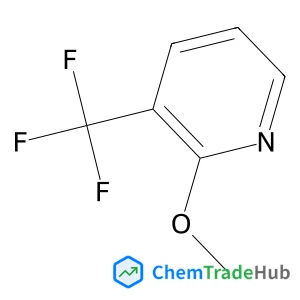
2-Methoxy-3-(trifluoromethyl)pyridine(CAS: 121643-44-5)
CAS Number
Related Products

1-Aminocyclobutanecarboxylic acid
CAS Number: 22264-50-2

![Potassium 4-[(4-fluorobenzyl)carbamoyl]-1-methyl-2-(2-{[(5-methyl-1,3,4-oxadiazol-2-yl)carbonyl]amino}-2-propanyl)-5,6-dioxo-1,2,5,6-tetrahydropyrimidin-2-ide](https://static.chemtradehub.com/structs/871/871038-72-1-53e3.webp)


Methyl icosanoate
CAS Number: 1120-28-1

![Imidazo[1,5-a]pyridine](https://static.chemtradehub.com/structs/274/274-47-5-b458.webp)
Imidazo[1,5-a]pyridine
CAS Number: 274-47-5

(1R,3S,5s,7s)-5-Hydroxy-2-adamantanone
CAS Number: 20098-14-0

Fomesafen
CAS Number: 72178-02-0
Other Suppliers for 2-Methoxy-3-(trifluoromethyl)pyridine





Basic Information
Molecular Formula
C7H6F3NO
Molecular Weight
177.12 g/mol
Physical Properties
Boiling Point
43-45℃/15mmHg(lit.)
Chemical Identifiers
SMILES
COC1=C(C=CC=N1)C(F)(F)F
InChIKey
SSAZZVQVJJXPMB-UHFFFAOYSA-N
Database References
MDL Number
MFCD00153202
FAQ
2-Methoxy-3-(trifluoromethyl)pyridine (CAS: 121643-44-5) must comply with various regulatory guidelines, including GHS classification, REACH regulations, and FDA/EPA requirements. It is classified as a hazardous substance due to its flammability and potential for environmental harm. Companies handling this compound should adhere to strict safety protocols and obtain necessary permits for its production, storage, and disposal.
There are several alternatives to 2-Methoxy-3-(trifluoromethyl)pyridine (CAS: 121643-44-5) in synthesis, including 2-Phenylpyridine and 3-Methoxy-2-(trifluoromethyl)pyridine. These alternatives can serve as effective reagents in various reactions, providing similar functionalities. However, the choice of alternative depends on the specific application, availability, and cost.
The market for 2-Methoxy-3-(trifluoromethyl)pyridine (CAS: 121643-44-5) is growing due to its application in pharmaceuticals and agrochemicals. Research is focusing on developing more sustainable and environmentally friendly synthesis methods. Additionally, there is increasing interest in exploring its use in new drug discovery and as a precursor in organic synthesis.
Waste containing 2-Methoxy-3-(trifluoromethyl)pyridine (CAS: 121643-44-5) should be collected and handled according to hazardous waste regulations. Proper storage in sealed containers is essential, and disposal should be through professional waste management services. Incineration is a common method for disposal, but it must be conducted in an environmentally safe manner to prevent contamination. Always ensure compliance with local and national regulations for hazardous waste management.
Safety Notice
Please verify product specifications and safety data before use. Contact the supplier for detailed safety information.
Always follow proper handling procedures
Contact Information
new_great@163.com