



AD
2-Chloro-1,3,2-dioxaphospholane 2-oxide(CAS: 6609-64-9)
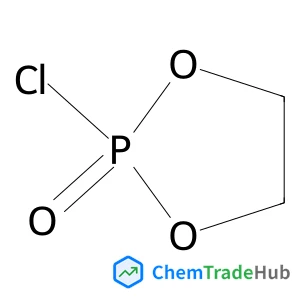
CAS Number
Related Products
![2,7-Bis(4-aminophenyl)benzo[lmn][3,8]phenanthroline-1,3,6,8(2H,7H)-tetrone](https://static.chemtradehub.com/structs/495/49546-11-4-93ac.webp)

![7-Fluoro-2,3-dihydropyrrolo[2,1-b]quinazolin-9(1H)-one](https://static.chemtradehub.com/structs/380/380638-36-8-59fd.webp)


![1,1'-Biphenyl]-4-carboxylic acid, 4'-[2-(4'-carboxy[1,1'-biphenyl]-4-yl)-1,2-diphenylethenyl]-](https://static.chemtradehub.com/structs/225/2256821-87-9-f6da.webp)
![2'-Bromo-2,7-bis(2-methyl-2-propanyl)-9,9'-spirobi[fluorene]](https://static.chemtradehub.com/structs/393/393841-81-1-12f0.webp)


Other Suppliers for 2-Chloro-1,3,2-dioxaphospholane 2-oxide





Basic Information
Molecular Formula
C2H4ClO3P
Molecular Weight
142.48 g/mol
Physical Properties
Melting Point
12-14 °C (neat) (lit.)
Boiling Point
91°C/0.8mmHg(lit.)
Density
1.55 g/mL at 25 °C(lit.)
Water Solubility
Miscible with water and chloroform.
Chemical Identifiers
SMILES
C1COP(=O)(O1)Cl
InChIKey
SBMUNILHNJLMBF-UHFFFAOYSA-N
Database References
MDL Number
MFCD00043138
Beilstein Registry Number
606582
FAQ
2-Chloro-1,3,2-dioxaphospholane 2-oxide (CAS: 6609-64-9) is a crystalline compound with a molecular weight of approximately 130.53 g/mol. It has a low solubility in water but is soluble in organic solvents like acetone and dimethylformamide. This compound is highly reactive, particularly towards nucleophiles, making it useful in various organic transformations. It is stable under normal conditions but should be stored away from moisture and heat.
2-Chloro-1,3,2-dioxaphospholane 2-oxide (CAS: 6609-64-9) is typically synthesized through the reaction of phosphorus oxychloride and 2-hydroxy-1,3-dioxolane. This process involves the substitution of the hydroxyl group by a chlorine atom, followed by the formation of the 2-oxide. The reaction is usually carried out in a solvent like dichloromethane and requires careful control of temperature and reaction conditions to achieve high yield and selectivity.
2-Chloro-1,3,2-dioxaphospholane 2-oxide (CAS: 6609-64-9) is primarily used in the pharmaceutical industry for the synthesis of various bioactive compounds. It is also utilized in the polymer industry for the modification of polymers, in the development of sensors for detecting specific chemicals, and in semiconductor manufacturing for etching and cleaning processes.
When handling 2-Chloro-1,3,2-dioxaphospholane 2-oxide (CAS: 6609-64-9), it is essential to wear appropriate personal protective equipment (PPE), including gloves, goggles, and a lab coat. This compound should be used in a well-ventilated area or a fume hood to minimize exposure. Spills should be cleaned up immediately using appropriate absorbents, and the area should be flushed with water. Storage should be in a cool, dry place away from moisture and other reactive chemicals. Always refer to the Safety Data Sheet (SDS) for detailed safety information and emergency procedures.
Safety Notice
Please verify product specifications and safety data before use. Contact the supplier for detailed safety information.
Always follow proper handling procedures
Contact Information
2853979818@qq.com