



AD
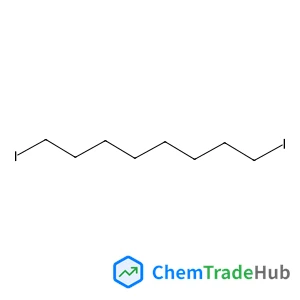
1,8-Diiodooctane(CAS: 24772-63-2)
CAS Number
Related Products
![Ethyl 4-(2-{4,5-bis[4-(ethoxycarbonyl)phenyl]-1,3-dithiol-2-ylidene}-5-[4-(ethoxycarbonyl)phenyl]-1,3-dithiol-4-yl)benzoate](https://static.chemtradehub.com/structs/135/1356336-61-2-b5d1.webp)
![1-[(3aS,8aS)-2,2-Dimethyl-4,4,8,8-tetraphenyltetrahydro[1,3]dioxolo[4,5-e][1,3,2]dioxaphosphepin-6-yl]piperidine](https://static.chemtradehub.com/structs/582/582300-11-6-7e49.webp)
![2-[(5-Phenyl-2-pyrimidinyl)amino]ethanol](https://static.chemtradehub.com/structs/298/298217-37-5-72d8.webp)
Other Suppliers for 1,8-Diiodooctane






Basic Information
Molecular Formula
C8H16I2
Molecular Weight
366.02 g/mol
Physical Properties
Melting Point
16-21 °C
Boiling Point
144°C/2mmHg(lit.)
Chemical Identifiers
SMILES
C(CCCCI)CCCI
InChIKey
KZDTZHQLABJVLE-UHFFFAOYSA-N
Database References
MDL Number
MFCD00001106
Beilstein Registry Number
1735437
FAQ
1,8-Diiodooctane (CAS: 24772-63-2) falls under the purview of various regulatory guidelines. It is classified under the GHS (Globally Harmonized System of Classification and Labelling of Chemicals) as an oxidizing and corrosive agent. For European markets, it must comply with REACH regulations, which require detailed reporting of its presence and use. Additionally, the FDA and EPA have specific requirements for chemicals used in pharmaceutical and environmental applications, respectively. Proper documentation and handling are essential to ensure compliance with these regulations.
In the synthesis of functionalized alkyl iodides, 1,8-Diiodooctane (CAS: 24772-63-2) is often used due to its stability and reactivity. However, there are alternative reagents such as 1-iodooctane or other alkyl iodides with similar functional groups. These can serve as viable substitutes depending on the specific reaction conditions and the desired product. The choice of alternative depends on factors like availability, cost, and the specific requirements of the synthesis.
The market for 1,8-Diiodooctane (CAS: 24772-63-2) is primarily driven by its use in organic synthesis, particularly in the preparation of functionalized alkyl iodides. Research trends are focusing on its application in pharmaceuticals and materials science, where its unique properties make it a valuable compound. Recent studies are also exploring its use as an oxidizing agent and its potential in environmental remediation. The trend indicates growing interest in its versatility and expanding application areas.
Waste containing 1,8-Diiodooctane (CAS: 24772-63-2) should be managed with care due to its corrosive and potentially harmful nature. Proper collection and disposal methods include segregating the waste from other chemicals and storing it in appropriate containers. For disposal, it is recommended to use professional waste disposal services that specialize in handling hazardous chemicals. Environmental precautions include ensuring that the waste is neutralized or treated before disposal to prevent contamination. Compliance with local and international regulations is crucial to ensure safe handling and disposal of this waste material.
Safety Notice
Please verify product specifications and safety data before use. Contact the supplier for detailed safety information.
Always follow proper handling procedures
Contact Information
shenlinxing@macklin.cn
Mobile
15221275939
Telephone
021-50706066
Fax
021-50706099
Visit Website
https://www.macklin.cn