



AD
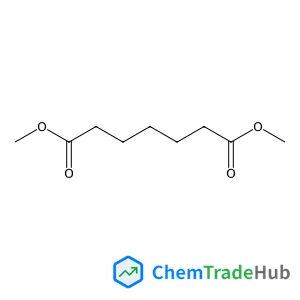
Dimethyl pimelate(CAS: 1732-08-7)
CAS Number
Related Products
methyl}benzamide](https://static.chemtradehub.com/structs/224/2247491-97-8-c197.webp)
![4-Amino-2-({[(2-methyl-2-propanyl)oxy]carbonyl}amino)butanoic acid](https://static.chemtradehub.com/structs/289/2899-79-8-863a.webp)
![2-Methyl-2-propanyl 7-(4,4,5,5-tetramethyl-1,3,2-dioxaborolan-2-yl)-2-azaspiro[4.4]nonane-2-carboxylate](https://static.chemtradehub.com/structs/230/2304631-27-2-21b7.webp)
![Methyl 3-(4-{3-[3-(trifluoromethyl)phenyl]-1H-pyrazol-5-yl}-1-piperidinyl)propanoate](https://static.chemtradehub.com/structs/103/1030386-15-2-7851.webp)
Other Suppliers for Dimethyl pimelate





Basic Information
Molecular Formula
C9H16O4
Molecular Weight
188.22 g/mol
Physical Properties
Melting Point
-21°C
Boiling Point
122°C/11mmHg(lit.)
Water Solubility
Soluble in ethanol, benzene, ether. Slightly soluble in water.
Chemical Identifiers
SMILES
COC(=O)CCCCCC(=O)OC
InChIKey
SHWINQXIGSEZAP-UHFFFAOYSA-N
Database References
MDL Number
MFCD00008470
Beilstein Registry Number
1777309
FAQ
Dimethyl pimelate (CAS: 1732-08-7) must comply with various regulatory guidelines. In Europe, it falls under the scope of REACH regulations, which require registration and evaluation of chemicals. In the U.S., it is subject to the Toxic Substances Control Act (TSCA) managed by the EPA. FDA regulations may also apply if the compound is intended for pharmaceutical or food contact use. Additionally, the United Nations' GHS (Global Harmonized System of Classification and Labeling of Chemicals) provides guidelines for classification and labeling of hazardous chemicals.
There are several alternatives to Dimethyl pimelate (CAS: 1732-08-7) in synthesis, depending on the specific application. For example, other dicarboxylic acids or their derivatives, such as adipic acid or succinic acid, can be used as starting materials. Isomeric forms or analogs, like dimethyl succinate, may also serve as viable alternatives. The choice of alternative reagents depends on reactivity, cost, and availability.
The market for Dimethyl pimelate (CAS: 1732-08-7) is growing due to its application in various industries, including pharmaceuticals, agrochemicals, and polymer additives. Research trends focus on its use as a plasticizer and its potential as a bio-based alternative to traditional petroleum-derived monomers. Emerging studies are exploring its role in sustainable chemical synthesis and its effects on biodegradability and environmental impact.
Waste containing Dimethyl pimelate (CAS: 1732-08-7) should be handled in accordance with local environmental regulations and safety guidelines. Proper waste collection should involve neutralization or detoxification if necessary, followed by incineration or professional waste disposal services. Environmental protection precautions include the use of appropriate personal protective equipment (PPE) and containment to prevent spills or leaks. Ensure that waste is disposed of in facilities certified for hazardous chemical disposal to minimize environmental impact.
Safety Notice
Please verify product specifications and safety data before use. Contact the supplier for detailed safety information.
Always follow proper handling procedures
Contact Information
Contact Person
Manager Gu
sales@gh-reagent.com
Mobile
18939883912
Telephone
021-34536277
Visit Website
https://www.gh-reagent.com/Address
No. 91, Building 2, Block 537, Sanada Road, Minhang District, Pujiang Town, Shanghai