



AD
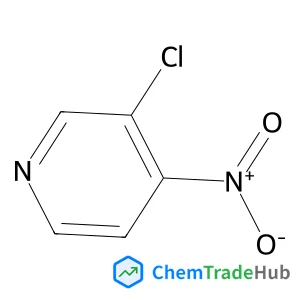
3-Chloro-4-nitropyridine(CAS: 13194-60-0)
CAS Number
Related Products

![2-[4-(4-Morpholinyl)-1,2,5-thiadiazol-3-yl] (R)-(+)-Timolol Ether](https://static.chemtradehub.com/structs/139/1391068-05-5-bbd2.webp)
![N,7,7-trimethyl-2-oxabicyclo[3.2.0]heptan-6-amine hydrochloride](https://static.chemtradehub.com/structs/133/1333782-52-7-7eaa.webp)

(4S)-4-Isopropyldihydro-2(3H)-furanone
CAS Number: 53657-15-1


4-Cyclopropyl-1,3-oxazolidin-2-one
CAS Number: 1378260-65-1
![2-(2-Imino-2,3-dihydro-1,3-thiazol-4-yl)-N-(4-{2-[(2-phenylethyl)amino]ethyl}phenyl)acetamide](https://static.chemtradehub.com/structs/158/1581284-82-3-56c4.webp)
![4-oxaspiro[bicyclo[3.2.0]heptane-6,1'-cyclobutan]-7-ol](https://static.chemtradehub.com/structs/142/1423028-41-4-73fe.webp)
Other Suppliers for 3-Chloro-4-nitropyridine







Basic Information
Molecular Formula
C5H3ClN2O2
Molecular Weight
158.54 g/mol
Physical Properties
Melting Point
25-26 ºC
Boiling Point
256 ºC
Flash Point
108 ºC
Chemical Identifiers
SMILES
C1=CN=CC(=C1[N+](=O)[O-])Cl
InChIKey
CWLVEHGKYCYAIO-UHFFFAOYSA-N
Database References
MDL Number
MFCD00490146
FAQ
3-Chloro-4-nitropyridine (CAS: 13194-60-0) is regulated under the Globally Harmonized System of Classification and Labelling of Chemicals (GHS) as a hazardous substance. It is classified under GHS categories: Skin corrosion/irritation Category 2, Serious eye damage/eye irritation Category 2, and Specific target organ toxicity (single exposure) Category 3 (respiratory tract irritation). In Europe, it is covered by REACH regulations, requiring manufacturers and importers to register it if the quantity used or imported exceeds one tonne per year. It is also listed under the U.S. EPA's Toxic Substances Control Act (TSCA) and the FDA's regulations for the safety of chemical substances.
While 3-Chloro-4-nitropyridine is a versatile intermediate in some synthetic routes, there are alternatives depending on the specific application. For example, 4-chloro-3-nitropyridine and 2-chloro-5-nitropyridine can be used as substitutes. In the synthesis of pyridine derivatives, 2-chloro-6-nitropyridine and 3-nitro-2-pyridone can also serve as effective alternatives. However, the choice of alternative often depends on the desired properties of the final product and the reactivity of the substituents.
The market for 3-Chloro-4-nitropyridine (CAS: 13194-60-0) reflects its use in various industries, including pharmaceuticals, agrochemicals, and fine chemicals. Recent research trends indicate an increasing focus on the development of novel pyridine derivatives for medicinal applications, particularly in the treatment of inflammatory and neurodegenerative diseases. Market analysis suggests steady demand, with price stability due to consistent production and moderate consumption. Emerging research is exploring its use in cancer therapy and as a precursor in organic synthesis.
Handling waste containing 3-Chloro-4-nitropyridine (CAS: 13194-60-0) requires careful consideration due to its hazardous nature. Waste should be collected in appropriate containers and stored separately to prevent contamination. For laboratory-scale waste, it is recommended to neutralize the waste with a base before disposal. For larger quantities, professional waste disposal services should be utilized. Proper incineration is a common method, but it must be conducted in compliance with local regulations. Environmental protection measures include ensuring no hazardous materials leach into the soil or groundwater, and all disposal activities should follow GHS guidelines to ensure worker safety.
Safety Notice
Please verify product specifications and safety data before use. Contact the supplier for detailed safety information.
Always follow proper handling procedures
Contact Information
Contact Person
Mr. Zhong
3287908757@qq.com