



AD
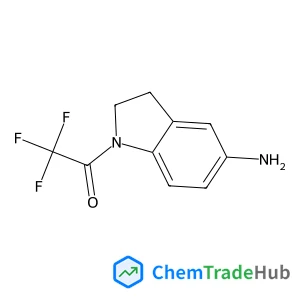
1-(5-Aminoindolin-1-Yl)-2,2,2-trifluoroethanone(CAS: 790677-27-9)
CAS Number
Related Products
methyl}benzamide](https://static.chemtradehub.com/structs/224/2247491-97-8-c197.webp)
![4-Amino-2-({[(2-methyl-2-propanyl)oxy]carbonyl}amino)butanoic acid](https://static.chemtradehub.com/structs/289/2899-79-8-863a.webp)
![2-Methyl-2-propanyl 7-(4,4,5,5-tetramethyl-1,3,2-dioxaborolan-2-yl)-2-azaspiro[4.4]nonane-2-carboxylate](https://static.chemtradehub.com/structs/230/2304631-27-2-21b7.webp)
![Methyl 3-(4-{3-[3-(trifluoromethyl)phenyl]-1H-pyrazol-5-yl}-1-piperidinyl)propanoate](https://static.chemtradehub.com/structs/103/1030386-15-2-7851.webp)
Other Suppliers for 1-(5-Aminoindolin-1-Yl)-2,2,2-trifluoroethanone

Basic Information
Molecular Formula
C10H9F3N2O
Molecular Weight
230.19 g/mol
Chemical Identifiers
SMILES
Nc1ccc2c(c1)CCN2C(=O)C(F)(F)F
InChIKey
VIVZNUFDVKYJRB-UHFFFAOYSA-N
Database References
MDL Number
MFCD14529089
FAQ
1-(5-Aminoindolin-1-Yl)-2,2,2-trifluoroethanone (CAS: 790677-27-9) may be subject to various regulatory guidelines depending on its intended use. It should comply with REACH regulations for chemical safety and registration in the European Union. In the U.S., it must meet FDA requirements for substance safety and EPA regulations for environmental protection. Additionally, it should follow GHS classification for handling and labeling. Specific regulations might also apply based on the country or region of use.
There are several alternatives to 1-(5-Aminoindolin-1-Yl)-2,2,2-trifluoroethanone in synthetic routes. For instance, trifluoromethylated amines or other trifluoromethylated compounds can be used as precursors. Additionally, isomers or analogs such as 1-(4-Aminoindolin-1-yl)-2,2,2-trifluoroethanone can serve as alternative starting materials. These alternatives provide flexibility in the synthesis and can be chosen based on availability and reactivity.
The market and research trends for 1-(5-Aminoindolin-1-Yl)-2,2,2-trifluoroethanone (CAS: 790677-27-9) are primarily driven by its potential applications in pharmaceuticals and materials science. Research is ongoing to explore its use as a precursor in organic synthesis and its utility in developing novel materials. Market trends suggest growing interest in compounds with trifluoromethyl groups due to their unique physicochemical properties. The trend indicates a steady increase in demand as new applications are discovered.
Waste containing 1-(5-Aminoindolin-1-Yl)-2,2,2-trifluoroethanone (CAS: 790677-27-9) should be handled according to local and international environmental regulations. Collection of waste should be done in dedicated containers, and it should be disposed of through professional waste disposal services. Incineration is a common method for disposal, but it should be conducted in an environmentally controlled incinerator. Additionally, proper safety precautions should be taken to prevent any release into the environment, and the waste should be treated to ensure it meets regulatory standards before disposal.
Safety Notice
Please verify product specifications and safety data before use. Contact the supplier for detailed safety information.
Always follow proper handling procedures
Contact Information
Contact Person
Manager Gu
sales@gh-reagent.com
Mobile
18939883912
Telephone
021-34536277
Visit Website
https://www.gh-reagent.com/Address
No. 91, Building 2, Block 537, Sanada Road, Minhang District, Pujiang Town, Shanghai