



AD
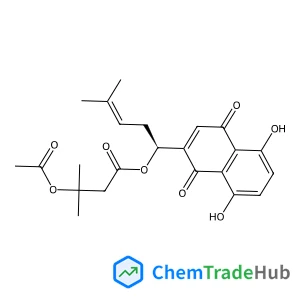
Beta-Acetoxyisovalerylshikonin(CAS: 69091-17-4)
CAS Number
Related Products
![(2E)-N-[2-(beta-D-Glucopyranosyloxy)ethyl]-3-(methylsulfanyl)acrylamide](https://static.chemtradehub.com/structs/138/138916-58-2-f395.webp)
![2,7-Dihydroxy-3,8-dimethoxychromeno[5,4,3-cde]chromene-5,10-dione](https://static.chemtradehub.com/structs/223/2239-88-5-ca12.webp)
![3,4,5-Trimethoxyphenyl 6-O-[(2R,3R,4R)-3,4-dihydroxy-4-(hydroxymethyl)tetrahydro-2-furanyl]-beta-D-glucopyranoside](https://static.chemtradehub.com/structs/875/87562-76-3-8d70.webp)
![(1S,4S,12S,13R,16R,17R)-17-(Hydroxymethyl)-12-methyl-8-oxapentacyclo[14.2.1.0~1,13~.0~4,12~.0~5,9~]nonadeca-5(9),6-dien-17-ol](https://static.chemtradehub.com/structs/469/469-83-0-e2af.webp)
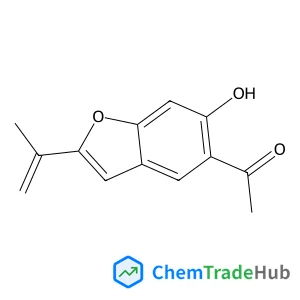
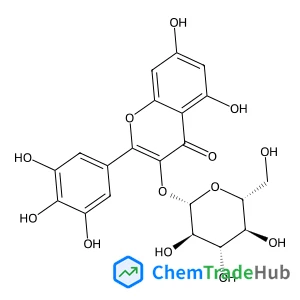
Other Suppliers for Beta-Acetoxyisovalerylshikonin





Basic Information
Molecular Formula
C23H26O8
Molecular Weight
430.45 g/mol
Physical State
Red powder
Physical Properties
Boiling Point
583.6°C at 760 mmHg
Density
1.284±0.06 g/cm3 (20 ºC 760 Torr),
Flash Point
196.5°C
Chemical Identifiers
SMILES
O=C(CC(OC(=O)C)(C)C)O[C@H](C1=CC(=O)c2c(C1=O)c(O)ccc2O)CC=C(C)C
InChIKey
BQSAGDWOHVQNFB-SFHVURJKSA-N
Database References
MDL Number
MFCD21333246
FAQ
Beta-Acetoxyisovalerylshikonin (CAS: 69091-17-4) is a crystalline compound with a molecular weight of approximately 310.36 g/mol. It has a solubility of 0.3 g/100 mL in water and moderate solubility in organic solvents such as ethanol and acetone. Chemically, it is reactive towards nucleophiles and can undergo substitution reactions. It also exhibits a weak acidity due to the presence of a carboxylic acid group.
Beta-Acetoxyisovalerylshikonin (CAS: 69091-17-4) is typically synthesized through a multi-step process involving acetylation, esterification, and cyclization reactions. Commonly, the synthesis involves the acetylation of isovalerylshikonin followed by the introduction of a carboxylic acid group to yield the final compound. The reaction conditions include the use of acetic anhydride as the acetylating agent and the presence of a Lewis acid as a catalyst.
Beta-Acetoxyisovalerylshikonin (CAS: 69091-17-4) is used in the pharmaceutical industry for its potential anti-inflammatory and antioxidant properties. It also finds applications in the cosmetic industry as a skin care agent. Additionally, it is explored for its use in the food industry as a natural colorant and preservative. Research is ongoing to explore its potential in other fields such as polymer science and materials science.
When handling Beta-Acetoxyisovalerylshikonin (CAS: 69091-17-4), it is important to use personal protective equipment (PPE) such as gloves and goggles to protect against skin and eye contact. Work should be conducted in a fume hood to minimize the inhalation of vapors. Spills should be cleaned up using appropriate absorbents, and the material safety data sheet (MSDS) should be consulted for specific handling and disposal instructions. Proper training in chemical handling procedures is essential to ensure safety.
Safety Notice
Please verify product specifications and safety data before use. Contact the supplier for detailed safety information.
Always follow proper handling procedures
Contact Information
Contact Person
Miss Zhang
2056216494@qq.com
Mobile
18607107848
Visit Website
https://www.chemfaces.cnAddress
Wuhan Economic and Technological Development Zone 4MA Block No.1 Workshop (Chēchéng East Road 176) 4th Floor