



AD
2-(4-Nitrophenyl)ethanamine hydrochloride (1:1)(CAS: 29968-78-3)
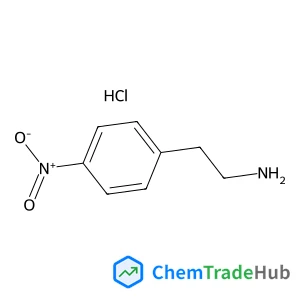
CAS Number
Related Products
![Cyclopentanol, 5-[2-[[(4-methoxyphenyl)diphenylmethyl]amino]-6-(phenylmethoxy)-9H-purin-9-yl]-3-(phenylmethoxy)-2-[(phenylmethoxy)methyl]-, (1S,2S,3S,5S)-](https://static.chemtradehub.com/structs/142/142217-78-5-5967.webp)
![2-Amino-9-{(1S,3R,4S)-4-(benzyloxy)-3-[(benzyloxy)methyl]-2-methylenecyclopentyl}-1,9-dihydro-6H-purin-6-one](https://static.chemtradehub.com/structs/142/142217-81-0-cd33.webp)
![5-[Bis(4-methylphenyl)methyl]-1H-1,2,4-triazole](https://static.chemtradehub.com/structs/112/112809-51-5-503e.webp)
Other Suppliers for 2-(4-Nitrophenyl)ethanamine hydrochloride (1:1)






Basic Information
Molecular Formula
C8H11ClN2O2
Molecular Weight
202.64 g/mol
Physical State
Pale-yellow to Yellow-brown Solid
Physical Properties
Melting Point
200 °C (dec.) (lit.)
Boiling Point
No data available
Density
1.206
Flash Point
No data available
Chemical Identifiers
SMILES
C1=CC(=CC=C1CCN)[N+](=O)[O-].Cl
InChIKey
JVMHULJEYUQYSH-UHFFFAOYSA-N
Database References
MDL Number
MFCD00012900
Beilstein Registry Number
3568915
FAQ
2-(4-Nitrophenyl)ethanamine hydrochloride (1:1) is a chemical compound with the CAS number 29968-78-3. It is a white crystalline solid formed by the hydrochloride salt of 2-(4-nitrophenyl)ethanamine, characterized by its amine functional group and nitrophenyl substituent. The compound is commonly used as an intermediate in organic synthesis due to its reactivity and stability in aqueous solutions.
2-(4-Nitrophenyl)ethanamine hydrochloride (1:1) (CAS: 29968-78-3) is primarily used in pharmaceutical research as a precursor for drug development, particularly in the synthesis of antihistamines and antidepressants. It also serves as an industrial reagent for chemical modifications and in research applications for studying amine-nitro group interactions. Its utility stems from its ability to participate in various reaction mechanisms, making it valuable in organic chemistry.
2-(4-Nitrophenyl)ethanamine hydrochloride (1:1) (CAS: 29968-78-3) requires careful handling due to potential irritancy to skin, eyes, and respiratory systems. Safety standards advise using personal protective equipment (PPE) such as gloves, goggles, and lab coats. It is classified as a hazardous chemical under OSHA guidelines, so proper ventilation and avoidance of direct contact are essential for safe use and disposal.
Store 2-(4-Nitrophenyl)ethanamine hydrochloride (1:1) (CAS: 29968-78-3) in a cool, dry place (ideally 2-8°C), away from light and moisture. Use airtight containers to prevent exposure to humidity and air, ensuring stability and minimizing degradation. Keep it in a well-ventilated area to avoid inhalation risks associated with its solid form.
Safety Notice
Please verify product specifications and safety data before use. Contact the supplier for detailed safety information.
Always follow proper handling procedures
Contact Information
Contact Person
Chen Mimi
mandy@rdphrm.com