



AD
3,5-Di-tert-butyl-4-Hydroxybenzoic Acid(CAS: 1421-49-4)
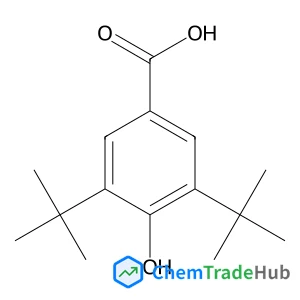
CAS Number
Related Products
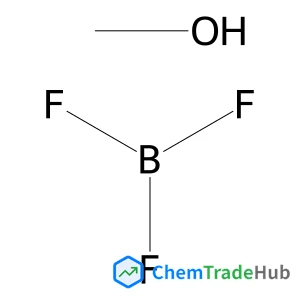
methanol; trifluoro-methoxy-boron
CAS Number: 2802-68-8
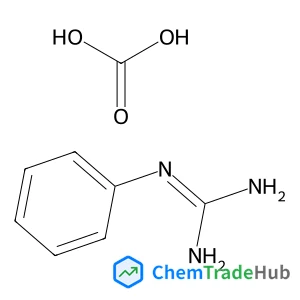
Carbonic acid - 1-phenylguanidine (1:1)
CAS Number: 6685-76-3
![1,7,7-Trimethylbicyclo[2.2.1]heptane-2,3-dione](https://static.chemtradehub.com/structs/103/10373-78-1-714c.webp)
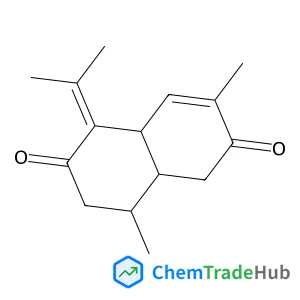
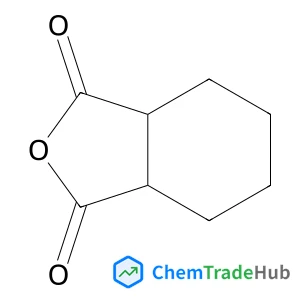
octahydro-2-benzofuran-1,3-dione
CAS Number: 85-42-7
![1-[(4xi)-beta-D-(~13~C_5_)-erythro-Pentofuranosyl]-1H-1,2,4-triazole-3-carboxamide](https://static.chemtradehub.com/structs/164/1646818-35-0-ea01.webp)
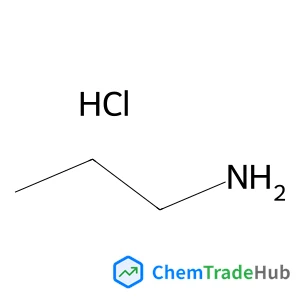
1-Propanamine hydrochloride (1:1)
CAS Number: 556-53-6
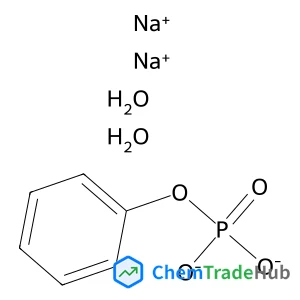
![1,1,2,2-Tetrafluoro-1-[2-(1,1,2,2-tetrafluoroethoxy)ethoxy]ethane](https://static.chemtradehub.com/structs/358/358-39-4-0089.webp)
Other Suppliers for 3,5-Di-tert-butyl-4-Hydroxybenzoic Acid



Basic Information
Molecular Formula
C15H22O3
Molecular Weight
250.34 g/mol
Physical Properties
Melting Point
208.0 to 213.0 deg-C
Boiling Point
353.47°C (rough estimate)
Flash Point
174 °C
Water Solubility
Insoluble in water.
Chemical Identifiers
SMILES
CC(C)(C)C1=CC(=CC(=C1O)C(C)(C)C)C(=O)O
InChIKey
YEXOWHQZWLCHHD-UHFFFAOYSA-N
Database References
MDL Number
MFCD00008827
Beilstein Registry Number
2216948
FAQ
3,5-Di-tert-butyl-4-Hydroxybenzoic Acid (CAS: 1421-49-4) falls under the regulatory guidelines of GHS classification, which categorizes it as a skin and eye irritant. In the EU, it is also regulated under REACH, requiring manufacturers and importers to register substances above a certain tonnage. FDA and EPA have specific requirements for its use in food and pharmaceutical applications, ensuring it meets safety standards.
Several alternatives can be used in the synthesis of 3,5-Di-tert-butyl-4-Hydroxybenzoic Acid (CAS: 1421-49-4), including 2,6-di-tert-butyl-4-hydroxyphenol. These alternatives often serve as antioxidants and can be used in similar applications, providing flexibility in chemical synthesis and formulation.
The market for 3,5-Di-tert-butyl-4-Hydroxybenzoic Acid (CAS: 1421-49-4) is showing steady growth due to its use as an antioxidant in various industries. Research trends are focusing on its applications in food preservation, pharmaceuticals, and cosmetics. There is also an increasing emphasis on sustainable production processes and eco-friendly formulations, which is driving innovation in its use.
Waste containing 3,5-Di-tert-butyl-4-Hydroxybenzoic Acid (CAS: 1421-49-4) should be carefully managed to avoid environmental contamination. Collect waste in appropriate containers and dispose of it through professional waste disposal services. Incineration is a common method for disposal, ensuring that it meets all regulatory requirements and environmental protection standards. Proper training and safety measures should be in place during the handling process.
Safety Notice
Please verify product specifications and safety data before use. Contact the supplier for detailed safety information.
Always follow proper handling procedures