



AD
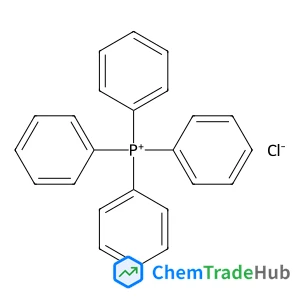
Tetraphenylphosphonium chloride(CAS: 2001-45-8)
CAS Number
Related Products

1,10-Phenanthroline-2,9-dicarbaldehyde
CAS Number: 57709-62-3

(3beta,24S)-Stigmasta-5,25-dien-3-ol
CAS Number: 2364-23-0

N-Acetyl-D-leucine
CAS Number: 99-15-0
![[1-(Methoxycarbonyl)-1H-indol-2-yl]boronic acid](https://static.chemtradehub.com/structs/100/1001162-89-5-faba.webp)

Ditelluroxomolybdenum
CAS Number: 12058-20-7

Azelnidipine
CAS Number: 123524-52-7

beta-Alanylhistidine
CAS Number: 9001-91-6

1-(6-Bromo-2-pyridinyl)methanamine
CAS Number: 188637-63-0

1-Phenylisoquinoline
CAS Number: 3297-72-1
Other Suppliers for Tetraphenylphosphonium chloride






Basic Information
Molecular Formula
C24H20ClP
Molecular Weight
374.8 g/mol
Physical Properties
Melting Point
272-274 °C (lit.)
Boiling Point
°Cat760mmHg
Flash Point
°C
Water Solubility
Soluble in water.
Chemical Identifiers
SMILES
C1=CC=C(C=C1)[P+](C2=CC=CC=C2)(C3=CC=CC=C3)C4=CC=CC=C4.[Cl-]
InChIKey
WAGFXJQAIZNSEQ-UHFFFAOYSA-M
Database References
MDL Number
MFCD00011916
Beilstein Registry Number
3922393
FAQ
Tetraphenylphosphonium chloride (CAS: 2001-45-8) falls under various regulatory guidelines. It is classified as a hazardous substance according to the Globally Harmonized System of Classification and Labeling of Chemicals (GHS). In the European Union, it is regulated under the REACH (Registration, Evaluation, Authorization and Restriction of Chemicals) framework. Additionally, the Food and Drug Administration (FDA) and Environmental Protection Agency (EPA) have specific guidelines for handling and disposing of this compound in the United States, focusing on its potential health and environmental impacts.
While Tetraphenylphosphonium chloride (CAS: 2001-45-8) is a widely used reagent in synthesis, alternatives include other organophosphonium salts like hexaphenylphosphonium chloride and triphenylphosphonium bromide. These alternatives can be chosen based on the specific requirements of the reaction, such as solubility, reactivity, and cost. It is important to evaluate these options to find the most suitable reagent for the intended application.
The market and research trends for Tetraphenylphosphonium chloride (CAS: 2001-45-8) are driven by its applications in organic synthesis and electrochemistry. Recent research has focused on its use in catalysis and as a supporting electrolyte in electrochemical cells. Market trends indicate growing interest in sustainable and environmentally friendly alternatives, leading to continuous exploration of new uses and formulations. However, due to its hazardous nature, there is also increasing emphasis on safer and more eco-friendly reagents.
Waste containing Tetraphenylphosphonium chloride (CAS: 2001-45-8) should be collected in appropriate containers and stored separately. Waste liquid can be neutralized with a base to reduce the risk of fire and then disposed of according to local regulations. Incineration is a common method, but professional disposal services should be used to ensure compliance with environmental protection standards. Proper personal protective equipment (PPE) should be worn during handling, and the area should be well-ventilated to minimize exposure risks.
Safety Notice
Please verify product specifications and safety data before use. Contact the supplier for detailed safety information.
Always follow proper handling procedures

Contact Information
1148980033@qq.com
Mobile
15827180502
Telephone
027-59210159
Fax
QQ:1148980033,1148380099
Visit Website
http://www.wande-chem.com