



AD
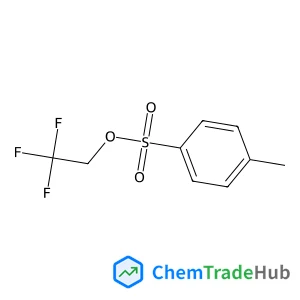
2,2,2-Trifluoroethyl 4-methylbenzenesulfonate(CAS: 433-06-7)
CAS Number
Related Products
![Ethyl bicyclo[2.2.1]hept-5-ene-2-carboxylate](https://static.chemtradehub.com/structs/101/10138-32-6-a6c4.webp)

Cyclobutylmethanol
CAS Number: 4415-82-1

1,5-Dibromo-3-methylpentane
CAS Number: 4457-72-1


Enalapril Impurity 4
CAS Number: 15121-89-8

![1-[2-(Ethylsulfonyl)ethyl]-2-methyl-5-nitro-1H-imidazole](https://static.chemtradehub.com/structs/193/19387-91-8-a76f.webp)
Other Suppliers for 2,2,2-Trifluoroethyl 4-methylbenzenesulfonate





Basic Information
Molecular Formula
C9H9F3O3S
Molecular Weight
254.23 g/mol
Physical Properties
Melting Point
38.0 to 42.0 deg-C
Boiling Point
104°C/0.8mmHg(lit.)
Chemical Identifiers
SMILES
CC1=CC=C(C=C1)S(=O)(=O)OCC(F)(F)F
InChIKey
IGKCQDUYZULGBM-UHFFFAOYSA-N
Database References
MDL Number
MFCD00000443
Beilstein Registry Number
2699394
FAQ
2,2,2-Trifluoroethyl 4-methylbenzenesulfonate (CAS: 433-06-7) is classified as a hazardous chemical under the Globally Harmonized System of Classification and Labeling of Chemicals (GHS). It is subject to the European Union's REACH regulations, which require registration, evaluation, authorization, and restriction of chemical substances. In the United States, it is regulated by the EPA and FDA for environmental and health safety. Proper handling, storage, and disposal must comply with these regulatory guidelines.
While 2,2,2-Trifluoroethyl 4-methylbenzenesulfonate (CAS: 433-06-7) is a useful reagent in organic synthesis, there are alternative compounds such as trifluoroethyl 4-chlorobenzenesulfonate and trifluoroethyl benzenesulfonate. These alternatives may offer similar functionalities but with different reactivity and stability, making them suitable for different synthetic routes.
The market for 2,2,2-Trifluoroethyl 4-methylbenzenesulfonate (CAS: 433-06-7) is growing due to its use in pharmaceuticals, agrochemicals, and material science. Research trends focus on exploring its applications in developing new drug molecules and as a protective group in synthetic chemistry. Market dynamics are influenced by increasing demand from the pharmaceutical industry and advancements in green chemistry approaches.
Waste containing 2,2,2-Trifluoroethyl 4-methylbenzenesulfonate (CAS: 433-06-7) should be collected and stored in appropriate containers lined with absorbent materials to prevent leakage. Disposal must follow local and international regulations, often involving incineration or professional waste disposal services. Environmental protection precautions include ensuring containment to prevent groundwater or soil contamination. Proper documentation and labeling are essential for safe handling and disposal.
Safety Notice
Please verify product specifications and safety data before use. Contact the supplier for detailed safety information.
Always follow proper handling procedures
Contact Information
Contact Person
Tuyu Tangmengting
1400868822@qq.com