



AD
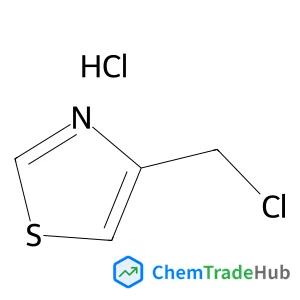
4-(Chloromethyl)-1,3-thiazole hydrochloride (1:1)(CAS: 7709-58-2)
CAS Number
Related Products
methyl}benzamide](https://static.chemtradehub.com/structs/224/2247491-97-8-c197.webp)
![4-Amino-2-({[(2-methyl-2-propanyl)oxy]carbonyl}amino)butanoic acid](https://static.chemtradehub.com/structs/289/2899-79-8-863a.webp)
![2-Methyl-2-propanyl 7-(4,4,5,5-tetramethyl-1,3,2-dioxaborolan-2-yl)-2-azaspiro[4.4]nonane-2-carboxylate](https://static.chemtradehub.com/structs/230/2304631-27-2-21b7.webp)
![Methyl 3-(4-{3-[3-(trifluoromethyl)phenyl]-1H-pyrazol-5-yl}-1-piperidinyl)propanoate](https://static.chemtradehub.com/structs/103/1030386-15-2-7851.webp)
Other Suppliers for 4-(Chloromethyl)-1,3-thiazole hydrochloride (1:1)




Basic Information
Molecular Formula
C4H5Cl2NS
Molecular Weight
170.06 g/mol
Physical Properties
Boiling Point
214.9°C at 760 mmHg
Density
1.338
Flash Point
83.8°C
Chemical Identifiers
SMILES
C1=C(N=CS1)CCl.Cl
InChIKey
NVTBASMQHFMANH-UHFFFAOYSA-N
Database References
MDL Number
MFCD02094738
FAQ
4-(Chloromethyl)-1,3-thiazole hydrochloride is a crystalline solid with a molecular weight of approximately 213.58 g/mol. It has a hydrochloride salt form, which enhances its solubility in water. This compound is moderately reactive, showing good reactivity with nucleophiles and capable of forming thioether bonds. It is sparingly soluble in water and ethanol but dissolves well in organic solvents like dichloromethane and acetonitrile.
4-(Chloromethyl)-1,3-thiazole hydrochloride is typically synthesized by first preparing 4-(chloromethyl)thiazole from thiazole and chloromethyl iodide. The reaction is usually conducted under anhydrous conditions. Subsequent treatment with hydrochloric acid forms the hydrochloride salt. This process involves the use of anhydrous solvents and amines to enhance reactivity and control side reactions. The yield is generally around 70-80%.
4-(Chloromethyl)-1,3-thiazole hydrochloride (CAS: 7709-58-2) finds application in the pharmaceutical industry, where it is used as a precursor for the synthesis of pharmaceuticals. It is also utilized in the polymer industry for the modification of polymers to improve their functional properties. Additionally, it is used in the fabrication of chemical sensors and semiconductors due to its reactivity and specific functional groups.
Proper handling of 4-(Chloromethyl)-1,3-thiazole hydrochloride requires the use of personal protective equipment (PPE), including gloves, goggles, and a lab coat. This compound should be handled in a well-ventilated area or under a fume hood due to its potential for inhalation hazards. Spills should be cleaned up using appropriate absorbent materials and the area flushed with water. In case of skin contact or inhalation, seek medical attention immediately. Safety data sheets (SDS) should always be consulted for detailed handling and safety information.
Safety Notice
Please verify product specifications and safety data before use. Contact the supplier for detailed safety information.
Always follow proper handling procedures
Contact Information
Contact Person
Manager Gu
sales@gh-reagent.com
Mobile
18939883912
Telephone
021-34536277
Visit Website
https://www.gh-reagent.com/Address
No. 91, Building 2, Block 537, Sanada Road, Minhang District, Pujiang Town, Shanghai