



AD
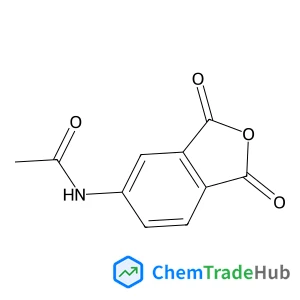
4-(Acetylamino)phthalic anhydride(CAS: 22235-04-7)
CAS Number
Related Products
![3-(1,4-Dihydro-5-methyl-4-oxo-7-propylimidazo[5,1-f][1,2,4]triazin-2-yl)-4-ethoxybenzenesulfonic Acid](https://static.chemtradehub.com/structs/437/437717-43-6-35ad.webp)
![1H-Benzimidazole, 6-(methoxy-d3)-2-[(S)-[[4-(methoxy-d3)-3,5-dimethyl-2-pyridinyl]methyl]sulfinyl]-, sodium salt (1:1)](https://static.chemtradehub.com/structs/922/922731-04-2-2fe5.webp)
![2-Butyl-4-chloro-1-{[2'-(1-trityl-1H-tetrazol-5-yl)-4-biphenylyl]methyl}-1H-imidazole-5-carbaldehyde](https://static.chemtradehub.com/structs/120/120568-18-5-a680.webp)

Other Suppliers for 4-(Acetylamino)phthalic anhydride




Basic Information
Molecular Formula
C10H7NO4
Molecular Weight
205.17 g/mol
Chemical Identifiers
SMILES
CC(=O)NC1=CC2=C(C=C1)C(=O)OC2=O
InChIKey
PFYOXMCPLCYYAQ-UHFFFAOYSA-N
Database References
MDL Number
MFCD01156609
FAQ
4-(Acetylamino)phthalic anhydride (CAS: 22235-04-7) falls under several regulatory frameworks. In the United States, it is regulated by the EPA under the Toxic Substances Control Act (TSCA) and the FDA may require certain safety data sheets (SDSs) depending on its intended use. Internationally, it must comply with REACH regulations in the EU, which require registration, evaluation, authorisation, and restriction of chemicals. Proper documentation and safety measures are essential to ensure compliance with these regulations.
For synthesizing similar functionalities, there are several alternatives to 4-(Acetylamino)phthalic anhydride (CAS: 22235-04-7). Common alternatives include 4-Aminophthalic anhydride and other anilide derivatives. These can serve as effective substitutes depending on the specific requirements of the reaction conditions. It is essential to consider the reactivity and solubility of the alternatives to ensure successful synthesis.
The market for 4-(Acetylamino)phthalic anhydride (CAS: 22235-04-7) is driven by its applications in the pharmaceutical and materials science industries. Research trends indicate increasing interest in its use as a precursor for developing new drug molecules and polymer additives. Additionally, the demand is expected to grow as it shows promise in enhancing material properties and biocompatibility. However, market dynamics are influenced by factors such as regulatory compliance and environmental concerns.
Handling waste containing 4-(Acetylamino)phthalic anhydride (CAS: 22235-04-7) requires careful attention to ensure safety and environmental protection. Waste should be collected in appropriate containers and labeled accordingly. For disposal, consider professional waste management services that comply with local and international regulations. Incineration is a common method, but ensure it is performed under controlled conditions to minimize environmental impact. Always follow safety protocols and consult the latest guidelines for proper disposal methods.
Safety Notice
Please verify product specifications and safety data before use. Contact the supplier for detailed safety information.
Always follow proper handling procedures
Contact Information
Contact Person
Wei Manager
Sales@artisbio.com