



AD
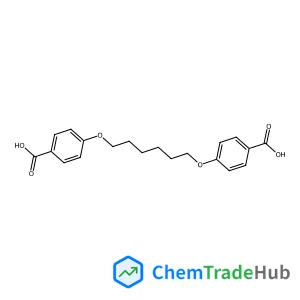
1,6-Bis(p-carboxyphenoxy)hexane(CAS: 74774-53-1)
CAS Number
Related Products
methyl}benzamide](https://static.chemtradehub.com/structs/224/2247491-97-8-c197.webp)
![4-Amino-2-({[(2-methyl-2-propanyl)oxy]carbonyl}amino)butanoic acid](https://static.chemtradehub.com/structs/289/2899-79-8-863a.webp)
![2-Methyl-2-propanyl 7-(4,4,5,5-tetramethyl-1,3,2-dioxaborolan-2-yl)-2-azaspiro[4.4]nonane-2-carboxylate](https://static.chemtradehub.com/structs/230/2304631-27-2-21b7.webp)
![Methyl 3-(4-{3-[3-(trifluoromethyl)phenyl]-1H-pyrazol-5-yl}-1-piperidinyl)propanoate](https://static.chemtradehub.com/structs/103/1030386-15-2-7851.webp)
Other Suppliers for 1,6-Bis(p-carboxyphenoxy)hexane





Basic Information
Molecular Formula
C20H22O6
Molecular Weight
358.39 g/mol
Physical Properties
Melting Point
278-290 °C
Boiling Point
580.1 °C at 760 mmHg
Density
1.238±0.06 g/cm3 (20 ºC 760 Torr),
Flash Point
205.7 °C
Chemical Identifiers
SMILES
C1=CC(=CC=C1C(=O)O)OCCCCCCOC2=CC=C(C=C2)C(=O)O
InChIKey
FQJXYULOQZUKBZ-UHFFFAOYSA-N
Database References
MDL Number
MFCD08276781
FAQ
1,6-Bis(p-carboxyphenoxy)hexane (CAS: 74774-53-1) falls under the GHS (Globally Harmonized System of Classification and Labeling of Chemicals) as a hazardous substance due to its potential toxicity. In the European Union, it is regulated under REACH (Registration, Evaluation, Authorization and Restriction of Chemicals) and must comply with specific safety data sheet (SDS) and labeling requirements. FDA and EPA have specific regulations for its use and disposal in the United States, including compliance with hazardous waste management guidelines.
There are several alternatives to 1,6-Bis(p-carboxyphenoxy)hexane (CAS: 74774-53-1) in synthesis, including 1,6-Hexanediol and various p-carboxyphenoxy compounds. These alternatives offer similar functionalities but may differ in reactivity, solubility, and synthesis complexity. Commonly, researchers and manufacturers opt for these alternatives based on availability, cost, and specific application requirements.
The market for 1,6-Bis(p-carboxyphenoxy)hexane (CAS: 74774-53-1) is primarily driven by its use in the production of coatings, adhesives, and plasticizers. Recent research trends focus on developing more sustainable and eco-friendly alternatives. Additionally, there is growing interest in its application in biomedical materials due to its biocompatibility. Market trends indicate a steady demand, with ongoing efforts to explore its applications in new fields.
Waste containing 1,6-Bis(p-carboxyphenoxy)hexane (CAS: 74774-53-1) should be collected in appropriate containers and labeled as hazardous waste. It should be disposed of in accordance with local and national regulations, typically through professional waste disposal services that specialize in hazardous chemicals. Incineration is one common method, provided it is conducted in an appropriately controlled environment. Environmental protection precautions include ensuring that waste is not released into the environment and that all handling procedures comply with safety guidelines.
Safety Notice
Please verify product specifications and safety data before use. Contact the supplier for detailed safety information.
Always follow proper handling procedures
Contact Information
Contact Person
Manager Gu
sales@gh-reagent.com
Mobile
18939883912
Telephone
021-34536277
Visit Website
https://www.gh-reagent.com/Address
No. 91, Building 2, Block 537, Sanada Road, Minhang District, Pujiang Town, Shanghai