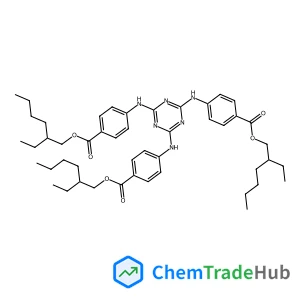
Tris(2-ethylhexyl) 4,4',4''-(1,3,5-triazine-2,4,6-triyltriimino)tribenzoate
CAS Number:
88122-99-0
Molecular Formula:
C48H66N6O6
Xu Li, Bin Wu, Ying Lv, Ru Xia, Jiasheng Qian
The high-performance electronic equipment appearing in the information age puts forward more comprehensive requirements for polymer-based composites with high heat dissipation capability, good mechanical properties, and substantial fire safety performance. However, the low interfacial interaction caused by the phase structural difference between the fillers greatly reduced the improvement of performance of the composites. It is feasible to overcome this issue by forming chemical interaction to regulate the interface structure. Herein, an anisotropic oriented composite is obtained by layer-by-layer self-assembly stacking of one-dimensional aramid nanofibers (ANFs) and ionic liquid (IL) functionalized two-dimensional boron nitride nanosheets (BNNSs). Considering the influence of the interface structure on the performance, the IL containing imidazolium ring and hexadecyl selected by density functional theory (DFT) form effective interface interactions with BNNSs. Owing to the establishment of multiple non-covalent bonding (cation–π, and CH–π) interactions, the composite exhibits not only high thermal conductivity (15.2 W m−1 K−1) and tensile strength (63.2 MPa) but also has excellent flame-retardant properties (limited oxygen index ≈ 45). Such an outstanding performance results in effectively cool light-emitting diode modules and desktop computers, outperforming a commercial thermal gasket. Significantly, molecular dynamics (MD) and DFT simulations further elucidate the role of IL in promoting heat transfer and the thermal conductivity mechanism between BNNS interfaces, respectively. This study offers a feasible strategy for constructing an interfacial structure by screening the modifier molecular configuration to perfect the excellent versatility of thermal management composites.
DOI: 10.1039/A705097F
DOI: 10.1039/AN995200096N
When handling lithium chloride hydrate (1:1:1) (CAS: 16712-20-2), it is importan...
4-(4H-1,2,4-Triazol-4-yl)piperidine is generally considered safe for use in phar...
Waste containing 1,3-Thiazole-2-carboxamide (CAS: 16733-85-0) should be collecte...
5-(Difluoromethyl)-2-fluorobenzonitrile (CAS: 934175-58-3) is subject to regulat...
Methyl 3-acetamido-2-thiophenecarboxylate can be synthesized by the reaction of ...
4-Isoquinolinecarbonitrile is a chemical compound with the CAS number 34846-65-6...
Store Methyl 1H-1,2,3-triazole-4-carboxylate (CAS: 877309-59-6) in a cool, dry p...
6-Bromo[1,3]thiazolo[5,4-b]pyridin-2-amine (CAS: 1160791-13-8) is subject to the...
(2S,3S)-2-Ammonio-3-(3,4-dihydroxyphenyl)-3-hydroxypropanoate (CAS: 23651-95-8) ...
7-Bromo-3-methyl-3,4-dihydroquinazolin-4-one is a solid with a crystalline form....

Journal of Materials Chemistry A, B & C cover high quality studies across all fields of materials chemistry. The journals focus on those theoretical or experimental studies that report new understanding, applications, properties and synthesis of materials. The journals have a strong history of publishing quality reports of interest to interdisciplinary communities and providing an efficient and rigorous service through peer review and publication. The journals are led by an international team of Editors-in-Chief and Associate Editors who are all active researchers in their fields. Journal of Materials Chemistry A, B & C are separated by the intended application of the material studied. Broadly, applications in energy and sustainability are of interest to Journal of Materials Chemistry A, applications in biology and medicine are of interest to Journal of Materials Chemistry B, and applications in optical, magnetic and electronic devices are of interest to Journal of Materials Chemistry C. More than one Journal of Materials Chemistry journal may be suitable for certain fields and researchers are encouraged to submit their paper to the journal that they feel best fits for their particular article. Example topic areas within the scope of Journal of Materials Chemistry A are listed below. This list is neither exhaustive nor exclusive. Artificial photosynthesis Batteries Carbon dioxide conversion Catalysis Fuel cells Gas capture/separation/storage Green/sustainable materials Hydrogen generation Hydrogen storage Photocatalysis Photovoltaics Self-cleaning materials Self-healing materials Sensors Supercapacitors Thermoelectrics Water splitting Water treatment

![1-(Hexopyranosyloxy)-4a,5-dihydroxy-7-methyl-1,4a,5,6,7,7a-hexahydrocyclopenta[c]pyran-7-yl 3-phenylacrylate structure](https://static.chemtradehub.com/structs/192/19210-12-9-ecae.webp "1-(Hexopyranosyloxy)-4a,5-dihydroxy-7-methyl-1,4a,5,6,7,7a-hexahydrocyclopenta[c]pyran-7-yl 3-phenylacrylate structure")