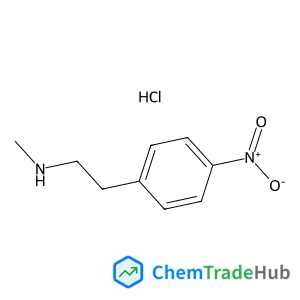
N-Methyl-2-(4-nitrophenyl)ethanamine hydrochloride (1:1)
CAS Number:
166943-39-1
Molecular Formula:
C9H13ClN2O2
Debashish Pal, Debayan Mondal, Dipanjan Maity, Debasis De, Mukhesh K. Ganesha, Ashutosh K. Singh, Gobinda Gopal Khan
Recently, various single-atom (SA) catalyst-coupled TiO2 nanostructures have been designed for photocatalytic hydrogen evolution. However, TiO2 is a well-established photoanode capable of solar-driven oxygen evolution reaction (OER). Selection and design of suitable oxygen evolution catalysts (OECs) boost the photoelectrochemical (PEC) water oxidation performance of TiO2. Various single-atom catalysts (SACs) are designed mainly for the electrochemical OER, while atomically dispersed SAs on TiO2 photoanodes for the photoelectrochemical (PEC) OER are still to be explored. Here, we demonstrate a rational and effective design of stabilizing Ru SAs dispersed on the CeOx catalyst (Ru:CeOx) coupled with one-dimensional (1D) Sb-doped TiO2 nanorods (Sb–TiO2 NRs) for remarkably enhanced PEC water oxidation activity. The role of Ru SAs in the electronic structure, separation, and transfer of photogenerated charge carriers and water oxidation pathways of the CeOx catalyst coupled photoanode has been investigated. Along with improved visible light absorption, the Ru:CeOx catalyst serves as an efficient hole extraction layer, inducing large interfacial band bending, large photovoltage generation, and shrinkage of the depletion layer, eventually accelerating the photogenerated hole transportation. DFT simulation demonstrates that Ru SA incorporation increases the conductivity of the catalyst, improving photocarrier transfer. Reduced photocarrier recombination, along with enhanced photocarrier transfer and injection rate enhance the photocurrent yield of the photoanode. DFT studies further confirm that Ru SAs significantly reduce the water oxidation overpotential of the neighboring active Ce atom sites, promoting the photoelectrochemical water oxidation activity of the CeOx catalyst. The optimal photoanode delivers a photocurrent density of 1.96 mA cm−2 (at 1.23 V vs. the reversible hydrogen electrode (RHE)), extremely low on-set potential (0.05 VRHE), peak ABPE value of 0.54%, and charge separation efficiency of 61.5% at 1.23 VRHE. This work provides an effective strategy to promote the water oxidation activity of metal oxide-supported SA catalysts to boost the overall performance of photoanodes.
Harald Fjeld, Kazuaki Toyoura, Reidar Haugsrud, Truls Norby
DOI: 10.1039/C002851G
Xun-Lei Ding, Sheng-Gui He
DOI: 10.1039/C0CP00360C
Ulrich Sternberg, Stephan L. Grage, Raiker Witter
DOI: 10.1039/B908236K
Sergei A. Dikanov, Rimma I. Samoilova, Reinhard Kappl, Antony R. Crofts, Jürgen Hüttermann
DOI: 10.1039/B904597J
Andrew P. S. Jurd, Jeremy J. Titman
DOI: 10.1039/B906814G
Manoj K. Singh
DOI: 10.1039/B821632K
Dmitrij Rappoport, Filipp Furche
DOI: 10.1039/B902098E
Sylvie Blanc, Thierry Pigot, Cyril Cugnet, Ross Brown, Sylvie Lacombe
DOI: 10.1039/C002705G
C. Laffon, J. Lasne, F. Bournel, K. Schulte, S. Lacombe, Ph. Parent
DOI: 10.1039/C0CP00229A
Andrei V. Astashkin, Eric L. Klein, Dmitry Ganyushin, Kayunta Johnson-Winters, Frank Neese, Ulrike Kappler, John H. Enemark
DOI: 10.1039/B907029J
When handling 2-Chloro-1,2-bis(4-methylphenyl)ethanone (CAS: 71193-32-3), it is ...
4-Ethoxy-3-(5-methyl-4-oxo-7-propyl-1,4-dihydroimidazo[5,1-f][1,2,4]triazin-2-yl...
Methyl 3-Oxo-4-Androsten-17-Carboxylate (CAS: 2681-55-2) should be stored in a c...
(R)-3-Amino-4-(3-hexylphenylamino)-4-oxobutylphosphonic acid is primarily used i...
2-Methyl-2-propanyl 3-amino-3-carbamoyl-1-azetidinecarboxylate (CAS: 1254120-14-...
There are alternative reagents that can be used in synthesis instead of (E)-4-(t...
[2-(3-Chlorophenyl)-1,3-thiazol-4-yl]methanol (CAS: 121202-20-8) is a crystallin...
The market and research trends for Methyl (2S)-[(4S)-2,2-dimethyl-1,3-dioxolan-4...
The market for 1-Bromo-2-isocyanatoethane (CAS: 42865-19-0) is driven by its use...
4-Nitro-D-phenylalanine hydrochloride (CAS: 147065-06-3) is primarily used in re...

Journal of Materials Chemistry A, B & C cover high quality studies across all fields of materials chemistry. The journals focus on those theoretical or experimental studies that report new understanding, applications, properties and synthesis of materials. The journals have a strong history of publishing quality reports of interest to interdisciplinary communities and providing an efficient and rigorous service through peer review and publication. The journals are led by an international team of Editors-in-Chief and Associate Editors who are all active researchers in their fields. Journal of Materials Chemistry A, B & C are separated by the intended application of the material studied. Broadly, applications in energy and sustainability are of interest to Journal of Materials Chemistry A, applications in biology and medicine are of interest to Journal of Materials Chemistry B, and applications in optical, magnetic and electronic devices are of interest to Journal of Materials Chemistry C. More than one Journal of Materials Chemistry journal may be suitable for certain fields and researchers are encouraged to submit their paper to the journal that they feel best fits for their particular article. Example topic areas within the scope of Journal of Materials Chemistry A are listed below. This list is neither exhaustive nor exclusive. Artificial photosynthesis Batteries Carbon dioxide conversion Catalysis Fuel cells Gas capture/separation/storage Green/sustainable materials Hydrogen generation Hydrogen storage Photocatalysis Photovoltaics Self-cleaning materials Self-healing materials Sensors Supercapacitors Thermoelectrics Water splitting Water treatment