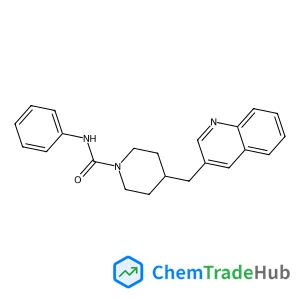
N-phenyl-4-(quinolin-3-ylmethyl)piperidine-1-carboxamide
CAS Number:
959151-50-9
Molecular Formula:
C22H23N3O
Qi Li, Yuan Zhu, Min Cheng, Li Du, Meihua Zhao, Gaoxia Zhang, Guangfu Wang, Wenjun Wang, Hongda Liu, Yongxi Chen, Wenjun Xiao
In recent years, bimetallic spinels (AB2X4) have played significant roles in energy and environmental remediation due to their excellent redox capacity. However, the disadvantages of traditional bimetallic spinels (blocky structure, low specific surface area, and poor reaction kinetics) limit their performances. Noting the controllable chemical composition, high specific surface area and strong design capability of metal–organic frameworks (MOFs), bimetallic spinels synthesized using them as sacrificial templates inherit the structural advantages of the parent materials and improve the inherent defects of traditional bimetallic spinels. These provide great opportunities for the application and development of bimetallic spinels. Therefore, this review presents two synthetic strategies for MOF-derived bimetallic spinels. Special emphasis is placed on the performance advantages of MOF-derived bimetallic spinels due to their unique variations. Based on this, recent advances in the energy field and environmental remediation as well as the mechanism of action are systematically reviewed. Finally, some issues and outlooks on their design are presented. This review aims to provide a systematic reference for the design of MOF-derived bimetallic spinels.
Tae Woong Kang, Atsushi Tamura, Yoshinori Arisaka, Nobuhiko Yui
DOI: 10.1039/D1PY00569C
Marc Guerre, Cédric Totée, Gilles Silly, Olinda Gimello, Bruno Améduri, Jean-François Tahon, Rinaldo Poli, Sophie Barrau, Vincent Ladmiral
DOI: 10.1039/D0PY01754J
Huiqun Wang, Sebla Onbulak, Steven Weigand, Frank S. Bates, Marc A. Hillmyer
DOI: 10.1039/D0PY01728K
Peter Černoch, Alessandro Jager, Zulfiya Černochová, Vladimir Sincari, Lindomar J. C. Albuquerque, Rafal Konefal, Ewa Pavlova, Fernando C. Giacomelli, Eliezer Jager
DOI: 10.1039/D1PY00141H
Younes Saadat, Kyungtae Kim, Reza Foudazi
DOI: 10.1039/D1PY00127B
Josina L. Bohlen, Bragavie Kulendran, Hannah Rothfuss, Peter W. Roesky
DOI: 10.1039/D1PY00552A
Randall A. Scanga, James F. Reuther
DOI: 10.1039/D0PY01558J
Hatice Mutlu, Hongjiao Li, Wolfgang Wenzel
DOI: 10.1039/D0PY01421D
Waste containing 2-Ethyl-4-Methyl-1H-Imidazole-5-Carbaldehyde (CAS: 88634-80-4) ...
Triethoxy(octyl)silane (CAS: 1385031-14-0) is widely used in the pharmaceuticals...
Several alternatives to 3-iodo-7-nitro-1H-indazole (CAS: 864724-64-1) exist in t...
Yes, there are alternatives to Benzene, bis[(trimethoxysilyl)ethyl] (CAS: 266317...
Isothiazole-3-carbonitrile (CAS: 1452-17-1) is generally considered safe when us...
(3-Chlorophenyl)methanol (CAS: 873-63-2) is considered low to moderately toxic. ...
(2S,3S)-2-Hydroxy-3-({[(2-methyl-2-propanyl)oxy]carbonyl}amino)-3-(2-naphthyl)pr...
Proper handling of methyl 2-(bromomethyl)-5-methoxybenzoate requires the use of ...
6,8-Dibromoimidazo[1,2-a]pyridine-2-carboxylic acid (CAS: 904805-36-3) is an aro...
3-Amino-5-bromo-2-pyridinecarbonitrile is considered safe when handled under pro...

Journal of Materials Chemistry A, B & C cover high quality studies across all fields of materials chemistry. The journals focus on those theoretical or experimental studies that report new understanding, applications, properties and synthesis of materials. The journals have a strong history of publishing quality reports of interest to interdisciplinary communities and providing an efficient and rigorous service through peer review and publication. The journals are led by an international team of Editors-in-Chief and Associate Editors who are all active researchers in their fields. Journal of Materials Chemistry A, B & C are separated by the intended application of the material studied. Broadly, applications in energy and sustainability are of interest to Journal of Materials Chemistry A, applications in biology and medicine are of interest to Journal of Materials Chemistry B, and applications in optical, magnetic and electronic devices are of interest to Journal of Materials Chemistry C. More than one Journal of Materials Chemistry journal may be suitable for certain fields and researchers are encouraged to submit their paper to the journal that they feel best fits for their particular article. Example topic areas within the scope of Journal of Materials Chemistry A are listed below. This list is neither exhaustive nor exclusive. Artificial photosynthesis Batteries Carbon dioxide conversion Catalysis Fuel cells Gas capture/separation/storage Green/sustainable materials Hydrogen generation Hydrogen storage Photocatalysis Photovoltaics Self-cleaning materials Self-healing materials Sensors Supercapacitors Thermoelectrics Water splitting Water treatment
![Methyl 8-azabicyclo[3.2.1]octane-3-carboxylate hydrochloride structure](https://static.chemtradehub.com/structs/179/179022-43-6-77f5.webp "Methyl 8-azabicyclo[3.2.1]octane-3-carboxylate hydrochloride structure")
![4-Nitrophenyl N-{[(2-methyl-2-propanyl)oxy]carbonyl}-L-isoleucinate structure](https://static.chemtradehub.com/structs/169/16948-38-2-c88f.webp "4-Nitrophenyl N-{[(2-methyl-2-propanyl)oxy]carbonyl}-L-isoleucinate structure")