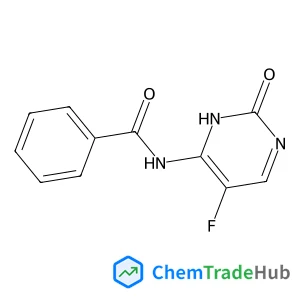
N-(5-Fluoro-2-oxo-2,3-dihydro-4-pyrimidinyl)benzamide
CAS Number:
10357-07-0
Molecular Formula:
C11H8FN3O2
Shengxin Sun, Juan Yang, Shengkun Li
The drimane sesquiterpene alkaloid halichonine B was isolated more than a decade ago, while only a very limited structure–activity relationship (SAR) was achieved in chemicobiology due to tedious synthesis (>10 steps) and inefficient modular derivatizations. Herein, a practical synthesis and divergent optimization of halichonine B is presented using the commercially inexpensive (+)-sclareolide, aiming at advancing chemicobiological exploration. Step-economic access (3 steps) to the core scaffold drimanyl amine was conceived and realized through an intramolecular Hofmann rearrangement, enabling a 6-step facile preparation of halichonine B. First agrochemical potential of this natural product and analogs was disclosed, facilitated by function-oriented rapid and modular diversifications including alkylated amines, amides, sulfamides, thioureas, and ureas. The unnatural mimic 10 and analog 12d were more effective against the cancer cell line HepG2 than cisplatin. The analog 12d was projected as a novel antifungal lead demonstrating >25-fold improvement than halichonine B against Rhizoctonia solani. Molecular docking differentiates halichonine B and the analog 12d by their interaction with the predictive target.

Organic Process Research & Development

Crystallography Reports

Chemical Communications

Russian Journal of Coordination Chemistry

Russian Journal of Organic Chemistry

Nature Medicine

Current Opinion in Colloid & Interface Science

Russian Journal of General Chemistry

Journal of Natural Medicines

Acta Materialia
Abu Md Asaduzzaman, Georg Schreckenbach
DOI: 10.1039/C1CP21168D
Jason Fang, Antonios Kelarakis, Yueh-Wei Lin, Chi-Yun Kang, Ming-Huan Yang, Cheng-Liang Cheng, Yue Wang, Emmanuel P. Giannelis, Li-Duan Tsai
DOI: 10.1039/C1CP22017A
Kwan Kim, Kyung Lock Kim, Jeong-Young Choi, Dongha Shin, Kuan Soo Shin
DOI: 10.1039/C1CP21249D
Yong-Feng Wang, Shan Xi Tian, Jinlong Yang
DOI: 10.1039/C1CP21267B
Maria Antonietta Loi
DOI: 10.1039/C1CP21146C
Pedro B. Coto, Luis Serrano-Andrés, Thomas Gustavsson, Takashige Fujiwara, Edward C. Lim
DOI: 10.1039/C1CP21089K
Junki Nagakubo, Minoru Ashizawa, Tadashi Kawamoto, Akihiko Tanioka
DOI: 10.1039/C1CP21507H
I. A. K. Young, C. Murray, C. M. Blaum, R. A. Cox, R. L. Jones, F. D. Pope
DOI: 10.1039/C1CP21337G
Micael J. T. Oliveira, Miguel A. L. Marques
DOI: 10.1039/C1CP20719A
2-Methylbenzene-1,4-diamine dihydrochloride (CAS: 615-45-2) should be stored in ...
(1S,4S)-2,5-Diazabicyclo[2.2.1]heptane dihydrobromide is generally considered sa...
(6-Chloropyridazin-3-YL)methanamine finds applications in the pharmaceutical ind...
2-Fluoro-3-methylphenol is primarily used in the synthesis of pharmaceuticals, p...
When handling 3-Methoxy-4-nitrobenzonitrile, it is important to wear appropriate...
When handling 1,3-Oxazolo[4,5-b]pyridine-2(3H)-thione (CAS: 211949-57-4), it is ...
4-Ethynylbenzamide (CAS: 90347-86-7) falls under various regulatory guidelines i...
3-(2-Ethylphenyl)-2-thioxo-4-imidazolidinone is primarily used as an intermediat...
(2-Fluoro-6-methoxyphenyl)acetic acid, also known as 4-fluoro-3-methoxybenzoic a...
Market trends for 2-[4-(Hydroxymethyl)phenoxy]ethanol (CAS: 102196-18-9) indicat...

Organic Chemistry Frontiers publishes high-quality research from across organic chemistry. Emphases are placed on studies that make significant contributions to the field of organic chemistry by reporting either new or significantly improved protocols or methodologies. Topics include, but are not limited to the following: Organic synthesis Development of synthetic methodologies Catalysis Natural products Functional organic materials Supramolecular and macromolecular chemistry Physical and computational organic chemistry

![[5-fluoro-2-(morpholine-4-carbonyl)phenyl]boronic acid structure](https://static.chemtradehub.com/structs/121/1217501-26-2-505c.webp "[5-fluoro-2-(morpholine-4-carbonyl)phenyl]boronic acid structure")