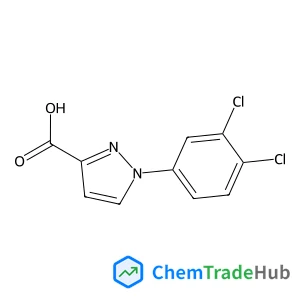
1-(3,4-Dichlorophenyl)-1H-pyrazole-3-carboxylic acid
CAS Number:
1152949-12-6
Molecular Formula:
C10H6Cl2N2O2
Luping Feng, Yu Qin, Xinhui Mu, Xuqing Zhong, Zhouyu Wang, Jingfang Li
Visible light-induced cross-dehydrogenative coupling is a general and highly efficient protocol for the synthesis of functionalized benzazepines/ones in a one-pot fashion, and is reported with good to excellent yields and high chemoselectivity. Control and electron paramagnetic resonance experiments reveal radical–radical cross-coupling and oxidative dehydrogenation processes via single-electron chemistry in this reaction. The reaction is free of metal catalysts and external oxidants, and has mild and redox-neutral reaction conditions. A coupling reaction rather than the addition of active benzocyclic imines and nucleophiles is first established. More importantly, the functionalized benzazepines/ones can be synthesized on the gram scale using a continuous-flow technique. The product benzo[d]thiazol-2-yldiphenylphosphine oxide presents superior flame retardancy in epoxy resin, in which only a 0.46 wt% ultra-low phosphorus loading is needed to reach the highest flame-retardant rating of the polymer material.
Andrew Das Arulsamy, Zlatko Kregar, Kristina Eleršič, Martina Modic, Uma Shankar Subramani
DOI: 10.1039/C1CP20138G
Ah-Young Jee, Seohyun Park, Minyung Lee
DOI: 10.1039/C1CP20835G
Christine Cézard, Frédéric Aubry, Florence Djedaïni-Pilard, François-Yves Dupradeau
DOI: 10.1039/C1CP20854C
Abu Md Asaduzzaman, Georg Schreckenbach
DOI: 10.1039/C1CP21168D
Carlos Randino, Marcin Ziółek, Ricard Gelabert, Juan Angel Organero, Michal Gil, Miquel Moreno, José M. Lluch, Abderrazzak Douhal
DOI: 10.1039/C1CP21039D
DOI: 10.1039/C1CP20622B
Zijing Ding, Liang Zhao, Liumin Suo, Yang Jiao, Sheng Meng, Yong-Sheng Hu, Zhaoxiang Wang, Liquan Chen
DOI: 10.1039/C1CP21513B
Yeonchoo Cho, Seung Kyu Min, Woo Youn Kim, Kwang S. Kim
DOI: 10.1039/C1CP20760A
Xavier Aparicio-Anglès, Anna Clotet, Josep M. Poblet
DOI: 10.1039/C0CP02602F
Nikolaos Bonanos, Jan Rossmeisl, Tejs Vegge
DOI: 10.1039/C1CP20406H
2-Methylbenzene-1,4-diamine dihydrochloride (CAS: 615-45-2) should be stored in ...
(1S,4S)-2,5-Diazabicyclo[2.2.1]heptane dihydrobromide is generally considered sa...
(6-Chloropyridazin-3-YL)methanamine finds applications in the pharmaceutical ind...
2-Fluoro-3-methylphenol is primarily used in the synthesis of pharmaceuticals, p...
When handling 3-Methoxy-4-nitrobenzonitrile, it is important to wear appropriate...
When handling 1,3-Oxazolo[4,5-b]pyridine-2(3H)-thione (CAS: 211949-57-4), it is ...
4-Ethynylbenzamide (CAS: 90347-86-7) falls under various regulatory guidelines i...
3-(2-Ethylphenyl)-2-thioxo-4-imidazolidinone is primarily used as an intermediat...
(2-Fluoro-6-methoxyphenyl)acetic acid, also known as 4-fluoro-3-methoxybenzoic a...
Market trends for 2-[4-(Hydroxymethyl)phenoxy]ethanol (CAS: 102196-18-9) indicat...

Organic Chemistry Frontiers publishes high-quality research from across organic chemistry. Emphases are placed on studies that make significant contributions to the field of organic chemistry by reporting either new or significantly improved protocols or methodologies. Topics include, but are not limited to the following: Organic synthesis Development of synthetic methodologies Catalysis Natural products Functional organic materials Supramolecular and macromolecular chemistry Physical and computational organic chemistry