













Unraveling ligand exchange reactions in linear neutral Au(i) and Cu(i) N-heterocyclic carbene complexes for biological applications
Literature Information
Publication Date
2023-12-27
DOI
10.1039/D3NJ04945K
Impact Factor
3.591
Authors
Gustavo C. Rodrigues, Manoel V. F. Barrionuevo, Miguel A. San-Miguel, Camilla Abbehausen
View Original
Abstract
Linear complexes of the form [M(NHC)Cl] (M = Au(I) or Cu(I), NHC = N-heterocyclic carbene) are promising drug candidates due to their potent in vitro antitumor, antibacterial, and antiparasitic activities. However, their speciation in biological environments is poorly understood, limiting their clinical translation. This study employed semiempirical GFN-xTB and density functional theory (DFT) calculations to investigate three biologically relevant ligand exchange reactions of these complexes: (1) chloride substitution with dimethylsulfoxide (DMSO), a common solvent used in in vitro studies; (2) ligand scrambling, which involves the rearrangement of ligands to form [M(NHC)2][MCl2]; and (3) chloride substitution with cysteine, a biologically relevant amino acid. Our calculations revealed that chloride replacement by DMSO is less favorable than ligand scrambling, particularly for Cu(I) complexes, suggesting that [M(NHC)Cl] is the most abundant species present in DMSO solution, followed by [M(NHC)2][MCl2]. Cysteine substitution was found to be the most thermodynamically and kinetically favorable reaction, potentially impacting the biological mechanism of action of these complexes. We also compared the reaction mechanisms between Au(I) and Cu(I) complexes by analyzing transition state geometries. Our findings provide new insights into the ligand exchange reactions of linear [M(NHC)Cl] complexes in biologically relevant environments. This information can be used to guide the design of new metal-based drugs with improved efficacy and selectivity.
Related Literature
Predicting nearest neighbor free energies of modified RNA with LIE: results for pseudouridine and N1-methylpseudouridine within RNA duplexes
Nivedita Dutta, Joanna Sarzynska, Indrajit Deb, Ansuman Lahiri
2023-11-24
Paper
DOI: 10.1039/D3CP02442C
Analysing the stability of He-filled hydrates: how many He atoms fit in the sII crystal?
Raquel Yanes-Rodríguez, Rita Prosmiti
2023-12-01
Paper
DOI: 10.1039/D3CP05410A
A nanoscale surface engineered magneto-mechano-triboelectric nanogenerator enabled by reliable pattern replication for self-powered IoT devices
Srinivas Pattipaka, Tae Wan Park, Young Min Bae, Yujin Na, Kyeongwoon Chung, Kwi-Il Park, Jungho Ryu, Woon Ik Park, Geon-Tae Hwang
2024-01-04
Paper
DOI: 10.1039/D3SE01206A
Refining protein amide I spectrum simulations with simple yet effective electrostatic models for local wavenumbers and dipole derivative magnitudes
Cesare M. Baronio, Andreas Barth
2023-12-15
Paper
DOI: 10.1039/D3CP02018E
Exploring the potential of cobalt hydroxide and its derivatives as a cost-effective and abundant alternative to noble metal electrocatalysts in oxygen evolution reactions: a review
Umair Shamraiz, Abdul Majeed, Bareera Raza, Noor ul Ain, Amin Badshah
2023-12-07
Review Article
DOI: 10.1039/D3SE00942D
The effects of water, substrate, and intermediate adsorption on the photocatalytic decomposition of air pollutants over nano-TiO2 photocatalysts
Zhifeng Lin, Xueding Jiang, Weicheng Xu, Fuhua Li, Xin Chen, Si Liu, Xihong Lu
2023-12-06
Review Article
DOI: 10.1039/D3CP04350A
Insights into the multi-functional lithium difluoro(oxalate)borate additive in boosting the Li-ion reaction kinetics for Li3VO4 anodes
Miaomiao Zhang, Cunyuan Pei, Qiqi Xiang, Lintao Liu, Zhongxu Dai, Huijuan Ma, Shibing Ni
2023-12-06
Paper
DOI: 10.1039/D3CP04952C
Growth mechanism prediction for nanoparticles via structure matching polymerization
Yi-Rong Liu, Yan Jiang
2023-12-06
Paper
DOI: 10.1039/D3CP04702D
Effect of the charge rate on the mechanical response of composite graphite electrodes: in situ experiment and mathematical analysis
Hainan Jiang, Yaolong He, Xiaolin Li, Zhiyao Jin, Huijie Yu, Dawei Li
2023-11-23
Paper
DOI: 10.1039/D3CP04274J
Investigating theoretical and experimental cross sections for elastic electron scattering from isoflurane
Bratislav P. Marinković, Jaime Rosado, Francisco Blanco, Gustavo García, Jelena B. Maljković
2023-12-07
Paper
DOI: 10.1039/D3CP05052A
You might also like
Compound Q&A
How should waste containing N-Methoxy-N-methyl-1,3-thiazole-5-carboxamide (CAS: 898825-89-3) be handled?
Waste containing N-Methoxy-N-methyl-1,3-thiazole-5-carboxamide (CAS: 898825-89-3...
898825-89-3N-Methoxy-N-methyl-1...
Compound Q&A
How should N-(4-Biphenylyl)dibenzo[b,d]furan-4-amine (CAS: 1318338-47-4) be stored?
N-(4-Biphenylyl)dibenzo[b,d]furan-4-amine should be stored in a tightly sealed c...
1318338-47-4N-(4-Biphenylyl)dibe...
Compound Q&A
What is the market or research trend for 3-Acetamido-5-amino-2,4,6-triiodobenzoic acid (CAS: 1713-07-1)?
The market for 3-Acetamido-5-amino-2,4,6-triiodobenzoic acid (CAS: 1713-07-1) is...
1713-07-13-Acetamido-5-amino-...
Compound Q&A
How should Benzyl 2-O-acetyl-3,4,6-tri-O-benzyl-beta-D-galactopyranoside (CAS: 61820-03-9) be stored?
Benzyl 2-O-acetyl-3,4,6-tri-O-benzyl-beta-D-galactopyranoside (CAS: 61820-03-9) ...
61820-03-9Benzyl 2-O-acetyl-3,...
Compound Q&A
What regulatory guidelines apply to 2-Ethylpiperazine dihydrochloride (CAS: 438050-52-3)?
2-Ethylpiperazine dihydrochloride (CAS: 438050-52-3) is regulated under the Glob...
438050-52-32-Ethylpiperazine di...
Compound Q&A
What regulatory guidelines apply to 1,1'-[1,3-Phenylenebis(methylene)]bis(3-methyl-1H-pyrrole-2,5-dione) (CAS: 119462-56-5)?
1,1'-[1,3-Phenylenebis(methylene)]bis(3-methyl-1H-pyrrole-2,5-dione) (CAS: 11946...
119462-56-51,1'-[1,3-Phenyleneb...
Compound Q&A
Are there alternatives to 5-Fluoro-2-(1-pyrrolidinyl)pyridine (CAS: 1287217-79-1) in synthesis?
Several alternatives can be used in the synthesis of 5-Fluoro-2-(1-pyrrolidinyl)...
1287217-79-15-Fluoro-2-(1-pyrrol...
Compound Q&A
What precautions should be taken when handling 1-((2R,3R,4R,5R)-5-((bis(4-methoxyphenyl)(phenyl)methoxy)methyl)-4-hydroxy-3-methoxytetrahydrofuran-2-yl)-5-methylpyrimidine-2,4(1H,3H)-dione (CAS: 153631-19-7)?
Proper personal protective equipment (PPE) must be worn when handling this compo...
153631-19-71-((2R,3R,4R,5R)-5-(...
Compound Q&A
What precautions should be taken when handling 6-Bromoimidazo[1,2-a]pyridin-8-amine (CAS: 676371-00-9)?
When handling 6-Bromoimidazo[1,2-a]pyridin-8-amine, it is important to wear appr...
676371-00-96-Bromoimidazo[1,2-a...
Compound Q&A
Are there alternatives to (2S,4R)-4-(4-Nitrobenzyl)pyrrolidine-2-carboxylic acid hydrochloride (CAS: 1049740-22-8) in synthesis?
Alternatives to (2S,4R)-4-(4-Nitrobenzyl)pyrrolidine-2-carboxylic acid hydrochlo...
1049740-22-8(2S,4R)-4-(4-Nitrobe...
Source Journal
New Journal of Chemistry

CiteScore:
5.3
Self-citation Rate:
3.7%
Articles per Year:
2153
NJC (New Journal of Chemistry) is a broad-based primary journal encompassing all branches of chemistry and its sub-disciplines. It contains full research articles, communications, perspectives and focus articles. This well-established journal, owned by the Centre National de la Recherche Scientifique (CNRS) of France, has been co-published with the Royal Society of Chemistry since January 1998. NJC is the forum for the publication of high-quality, original and significant work that opens new directions in chemistry or other scientific disciplines. In addition to having a significant chemical component, work published in NJC must demonstrate that it will have an impact on areas of research other than that of the reported work.
Recommended Compounds
![4-Chloro-2-{[(2-chlorophenoxy)acetyl]amino}benzoic acid structure](https://static.chemtradehub.com/structs/351/351424-20-9-9467.webp "4-Chloro-2-{[(2-chlorophenoxy)acetyl]amino}benzoic acid structure")
4-Chloro-2-{[(2-chlorophenoxy)acetyl]amino}benzoic acid
CAS Number:
351424-20-9
Molecular Formula:
C15H11Cl2NO4
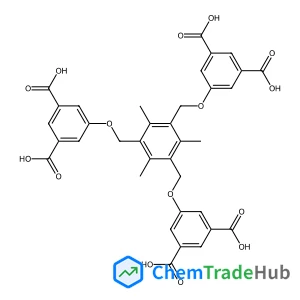
5,5',5''-(((2,4,6-Trimethylbenzene-1,3,5-triyl)tris(methylene))tris(oxy))triisophthalic acid
CAS Number:
1159974-70-5
Molecular Formula:
C36H30O15

4-(Dimethylaminomethyl)phenylacetic acid hydrochloride
CAS Number:
99985-52-1
Molecular Formula:
C11H16ClNO2
Recommended Suppliers





Disclaimer
This page provides academic journal information for reference and research purposes only. We are not affiliated with any journal publishers and do not handle publication submissions. For publication-related inquiries, please contact the respective journal publishers directly.
If you notice any inaccuracies in the information displayed, please contact us at support@chemtradehub.com. We will promptly review and address your concerns.