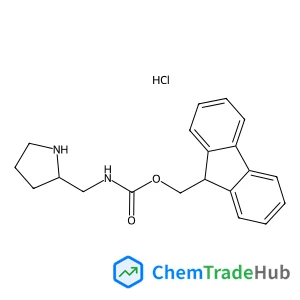
(S)-(9H-Fluoren-9-yl)methyl (pyrrolidin-2-ylmethyl)carbamate hydrochloride
CAS Number:
1217813-15-4
Molecular Formula:
C20H23ClN2O2
Tongshun An, Xiaowen Qin, Chenwei Liu, Weiheng Yuan, Tanyu Song, Zhiping Yin
The straightforward synthesis of trifluoromethylated N-heterocycles from readily available amines has attracted significant interest from the academic community. Herein, we established a general and sustainable electrochemical approach for synthesizing various trifluoromethylated pyrrolidines. By utilizing the inexpensive and easily accessible Langlois’ reagent as the source of CF3, a broad range of unactivated alkenes was transformed into corresponding heterocycles through a trifluoromethylation/cyclization cascade process in 43–80% yields. Mechanistic investigations indicated that this reaction may be initiated with the formation of a CF3 radical through anodic single-electron transfer oxidation. The great benefit of this protocol is avoiding the use of metal catalysts and oxidants. More importantly, the late-stage modification of celecoxib and large-scale synthesis have revealed exceptionally beneficial and potential applications of the present method.
Yu Qiu, Yanxin Yang, Enkang Fu, Rui Xiao
DOI: 10.1039/D3SE01168B
Ting Li, Zhongfu Yan, Mengjiao Liu, Xinyu Liu, Liang Liu, Jiahao Chen, Jianping Long
DOI: 10.1039/D3SE01334K
Md Al Mamunur Rashid, Sein Min, Sung Keon Namgoong, Keunhong Jeong
DOI: 10.1039/D3CP04310J
Bratislav P. Marinković, Jaime Rosado, Francisco Blanco, Gustavo García, Jelena B. Maljković
DOI: 10.1039/D3CP05052A
Srinivas Pattipaka, Tae Wan Park, Young Min Bae, Yujin Na, Kyeongwoon Chung, Kwi-Il Park, Jungho Ryu, Woon Ik Park, Geon-Tae Hwang
DOI: 10.1039/D3SE01206A
Fakhrul H. Bhuiyan, Ashlie Martini
DOI: 10.1039/D3CP05320B
Miaomiao Zhang, Cunyuan Pei, Qiqi Xiang, Lintao Liu, Zhongxu Dai, Huijuan Ma, Shibing Ni
DOI: 10.1039/D3CP04952C
Chengyong Zhong, Shuo Li
DOI: 10.1039/D3CP05005J
Jiarui Li, Tao Zeng, Zexing Qu, Yu Zhai, Hui Li
DOI: 10.1039/D3CP05278H
T. V. Pavlova, V. M. Shevlyuga
DOI: 10.1039/D3CP04962K
Waste containing N-Methoxy-N-methyl-1,3-thiazole-5-carboxamide (CAS: 898825-89-3...
N-(4-Biphenylyl)dibenzo[b,d]furan-4-amine should be stored in a tightly sealed c...
The market for 3-Acetamido-5-amino-2,4,6-triiodobenzoic acid (CAS: 1713-07-1) is...
Benzyl 2-O-acetyl-3,4,6-tri-O-benzyl-beta-D-galactopyranoside (CAS: 61820-03-9) ...
2-Ethylpiperazine dihydrochloride (CAS: 438050-52-3) is regulated under the Glob...
1,1'-[1,3-Phenylenebis(methylene)]bis(3-methyl-1H-pyrrole-2,5-dione) (CAS: 11946...
Several alternatives can be used in the synthesis of 5-Fluoro-2-(1-pyrrolidinyl)...
Proper personal protective equipment (PPE) must be worn when handling this compo...
When handling 6-Bromoimidazo[1,2-a]pyridin-8-amine, it is important to wear appr...
Alternatives to (2S,4R)-4-(4-Nitrobenzyl)pyrrolidine-2-carboxylic acid hydrochlo...

NJC (New Journal of Chemistry) is a broad-based primary journal encompassing all branches of chemistry and its sub-disciplines. It contains full research articles, communications, perspectives and focus articles. This well-established journal, owned by the Centre National de la Recherche Scientifique (CNRS) of France, has been co-published with the Royal Society of Chemistry since January 1998. NJC is the forum for the publication of high-quality, original and significant work that opens new directions in chemistry or other scientific disciplines. In addition to having a significant chemical component, work published in NJC must demonstrate that it will have an impact on areas of research other than that of the reported work.