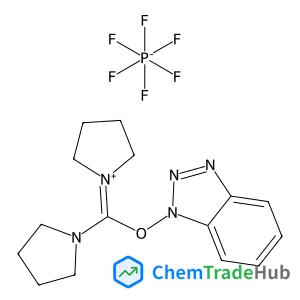
(1H-Benzotriazol-1-yloxy)(di-1-pyrrolidinyl)methylium hexafluorophosphate
CAS Number:
105379-24-6
Molecular Formula:
C15H21F6N5OP
Nguyen Dinh Thanh
Several substituted thiourea derivatives containing 6-carboalkoxybenzothiazole and D-glucose moieties 4a–i have been synthesized from the reaction of corresponding alkyl 2-aminobenzothiazole-6-carboxyl 2a–i with 2,3,4,6-tetra-O-acetyl-β-D-glucopyranosyl isothiocyanate. Their antimicrobial activity against bacteria (including Gram-positive and Gram-negative) and fungi were screened. The obtained results showed that several compounds exhibited significant inhibition abilities, including 4a, 4b, 4d, 4f, 4i (anti-Gram-positive bacterial), 4a, 4b, 4c, 4d, 4f (anti-Gram-negative bacterial), and 4b, 4d (anti-fungal) with MICs of 0.78–3.125 μg mL−1. Thioureas 4b, 4d, and 4i exhibited excellent inhibitory activity against S. aureus, in the order of 4d > 4b > 4i, with MICs of 0.78–1.56 μg mL−1. These inhibitors also expressed good inhibitory activity against S. aureus DNA gyrase and topoisomerase IV enzymes, especially compound 4d, which had IC50 values of 0.573 and 0.283 μM, respectively, against these tested enzymes. Molecular docking simulations and MM-GBSA calculations indicated that compound 4d interacted effectively with residues, including ALA1068, VAL1071, GLY1072, ASP1073, MET1075, GLY1076, ALA1120, MET1121 (chain B), ASP1088, MET1121, ARG1122 (chain D), DG10, and DC11 (chain E); DG10 and DC11 (chain F), just as the co-crystal interacted at the active site of S. aureus DNA gyrase (2XCS).
Dongpo Xu, Mingxia Gao, Chunhui Deng, Xiangmin Zhang
DOI: 10.1039/C6AN00361C
Yu Zong Chen
DOI: 10.1039/C6AN00678G
Julie V. Macpherson
DOI: 10.1039/C9AN01437C
Luca Guerrini
DOI: 10.1039/C9AN02040C
Xian Wang, Quan-Lan Liao, Shuai Zhao, Wei-Hua Huang, Yu-Qi Feng
DOI: 10.1039/C9AN01566C
Timothy P. Cleland, G. Asher Newsome, R. Eric Hollinger
DOI: 10.1039/C9AN01557D
Minghao Ren, Linfang Wang, Xin Lv, Yuanqiang Sun, Hu Chen, Keyuan Zhang, Qi Wu, Yurong Bai, Wei Guo
DOI: 10.1039/C9AN01852B
DOI: 10.1039/C9AN01162E
Liping Zhu, Jing Ye, Qiuju Zhu
DOI: 10.1039/C9AN01445D
When handling 4-(2-Furylmethyl)thiomorpholine 1,1-dioxide (CAS: 79206-94-3), it ...
When handling 4-Chloro-N-[2-(4-morpholinyl)ethyl]benzamide (CAS: 71320-77-9), it...
Waste containing this compound (CAS: 62921-74-8) should be handled according to ...
Waste containing (S)-Methyl 2-amino-3-cyclohexylpropanoate should be collected i...
This compound can be synthesized using a multi-step process involving the conjug...
There are several alternatives to (2E)-3-(3,4-Dichlorophenyl)acrylic acid in syn...
Ethyl 6-(2-nitrophenyl)imidazo[2,1-b][1,3]thiazole-3-carboxylate (CAS: 925437-84...
Waste containing 2-(1,3-Thiazol-2-yl)ethanamine (CAS: 18453-07-1) should be coll...
Methyl 5-iodo-2-methylbenzoate can be synthesized through the iodination of meth...
5-Chloro[1,2,4]triazolo[1,5-a]pyridine is commonly synthesized via the condensat...

NJC (New Journal of Chemistry) is a broad-based primary journal encompassing all branches of chemistry and its sub-disciplines. It contains full research articles, communications, perspectives and focus articles. This well-established journal, owned by the Centre National de la Recherche Scientifique (CNRS) of France, has been co-published with the Royal Society of Chemistry since January 1998. NJC is the forum for the publication of high-quality, original and significant work that opens new directions in chemistry or other scientific disciplines. In addition to having a significant chemical component, work published in NJC must demonstrate that it will have an impact on areas of research other than that of the reported work.