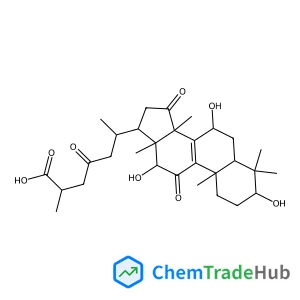
(3beta,7beta,12beta)-3,7,12-Trihydroxy-11,15,23-trioxolanost-8-en-26-oic acid
CAS Number:
98665-22-6
Molecular Formula:
C30H44O8
Xiao-Fang Qi, Can-Hao Li, Shu-Zhong Zhan
1,4,7,10-Tetraazacyclododecane (L) reacts with CoCl2 to provide a mononuclear cobalt complex, [Co(L)(Cl)2]Cl 1, which has been determined by X-ray crystallography. Complex 1 can serve as a new molecular catalyst for the oxygen reduction reaction (ORR). Under −0.4 V, the H2O2 yield is almost 100% with 0.20 M KOH. Investigations show that the formation of a cobalt(III)-peroxo species, [L-Co-OO]+ in solution is responsible for O2 reduction. In particular, this cobalt(III)-peroxo species has been isolated from the electrocatalytic system as a binuclear cobalt complex, [Co(L)(μ-OH) (μ-OO)Co(L)](ClO4)42 in the solid state. We hope that these findings can provide a new ideal for the development of electrocatalysts for the ORR.

Journal of Physics and Chemistry of Solids

Pure and Applied Chemistry

Journal of Medicinal Chemistry

Helvetica Chimica Acta

Fibre Chemistry

Israel Journal of Chemistry

Pharmacological Reviews

Journal of Organometallic Chemistry

Planta Medica

Proceedings of the National Academy of Sciences of the United States of America
Sebastian Schwalbe, Jana Schaber, Simon Krause, Irena Senkovska, Stefan Kaskel, Eike Brunner, Jens Kortus, Gotthard Seifert
DOI: 10.1039/C8CP04025G
DOI: 10.1039/C8CP91801E
Dan Guo, Guoxin Xie, Jian Li
DOI: 10.1039/C8CP01739E
DOI: 10.1039/C8CP03677B
Yosslen Aray, Antonio Díaz Barrios
DOI: 10.1039/C8CP03387K
Harish K. Choudhary, M. Manjunatha, R. Damle, K. P. Ramesh, B. Sahoo
DOI: 10.1039/C8CP01780H
Sehee Na, Sascha Jurkovic, Thorsten Friedrich, Thorsten Koslowski
DOI: 10.1039/C8CP02420K
Cheng-Xing Cui, Ganglong Cui
DOI: 10.1039/C8CP02651C
Yu-Hsuan Weng, Yu-Jane Sheng
DOI: 10.1039/C8CP03215G
Alejandro J. Garza
DOI: 10.1039/C8CP01963K
When handling 4-(2-Furylmethyl)thiomorpholine 1,1-dioxide (CAS: 79206-94-3), it ...
When handling 4-Chloro-N-[2-(4-morpholinyl)ethyl]benzamide (CAS: 71320-77-9), it...
Waste containing this compound (CAS: 62921-74-8) should be handled according to ...
Waste containing (S)-Methyl 2-amino-3-cyclohexylpropanoate should be collected i...
This compound can be synthesized using a multi-step process involving the conjug...
There are several alternatives to (2E)-3-(3,4-Dichlorophenyl)acrylic acid in syn...
Ethyl 6-(2-nitrophenyl)imidazo[2,1-b][1,3]thiazole-3-carboxylate (CAS: 925437-84...
Waste containing 2-(1,3-Thiazol-2-yl)ethanamine (CAS: 18453-07-1) should be coll...
Methyl 5-iodo-2-methylbenzoate can be synthesized through the iodination of meth...
5-Chloro[1,2,4]triazolo[1,5-a]pyridine is commonly synthesized via the condensat...

NJC (New Journal of Chemistry) is a broad-based primary journal encompassing all branches of chemistry and its sub-disciplines. It contains full research articles, communications, perspectives and focus articles. This well-established journal, owned by the Centre National de la Recherche Scientifique (CNRS) of France, has been co-published with the Royal Society of Chemistry since January 1998. NJC is the forum for the publication of high-quality, original and significant work that opens new directions in chemistry or other scientific disciplines. In addition to having a significant chemical component, work published in NJC must demonstrate that it will have an impact on areas of research other than that of the reported work.
![4-{2-[4-(2-Methyl-2-propanyl)phenyl]ethoxy}quinazoline structure](https://static.chemtradehub.com/structs/120/120928-09-8-d3db.webp "4-{2-[4-(2-Methyl-2-propanyl)phenyl]ethoxy}quinazoline structure")