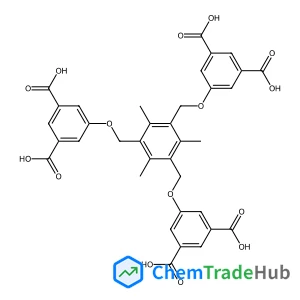
5,5',5''-(((2,4,6-Trimethylbenzene-1,3,5-triyl)tris(methylene))tris(oxy))triisophthalic acid
CAS Number:
1159974-70-5
Molecular Formula:
C36H30O15
Khiem Chau Nguyen, Duy T. M. Chung, Phattananawee Nalaoh, Jonathan S. Lindsey
A planned total synthesis of photosynthetic tetrapyrrole macrocycles installs essential stereochemical features in early precursors via established asymmetric methodology. Key building blocks are dihydrodipyrrins that contain a chiral pyrroline unit, for which chiral hex-5-yn-2-ones are valuable precursors. Chiral hex-5-yn-2-ones bearing diverse functional groups at the 1-position were sought that correspond to the chiral pyrroline units (rings B and D) of bacteriochlorophyll a. Three main results are reported herein. First, (2R,3R)-3-ethyl-2-methylpent-4-ynoic acid, prepared via a Schreiber-modified Nicholas reaction, was converted to the analogous chiral Weinreb pentynamide. The latter was treated with tributyltin-one-carbon synthons to create a 1-hydroxyhex-5-yn-2-one scaffold containing the two requisite stereocenters and with the newly introduced hydroxy group in free form or protected as the Me, MOM, THP, MEM, Bn, or SEM derivative. Second, improved routes to intermediates on the path to the pre-B compound, (3R,4R)-1,1-dimethoxy-3-ethyl-4-methylhex-5-yn-2-one, were developed, in part by derivatization of the chiral Weinreb pentynamide. Third, one (semisynthetic) chiral hexynone bearing a native phytyl substituent, a near-universal precursor to ring D of photosynthetic hydroporphyrins, was prepared in 2.5 mmol quantity. The synthesis and manipulation were achieved while maintaining stereochemical integrity in these somewhat densely functionalized chiral hexynones (three functional groups and two stereocenters in a six-carbon scaffold). Altogether, 22 new compounds have been prepared, including 15 chiral hexynones for studies in (bacterio)chlorophyll synthetic methodology. The chiral hexynones were prepared in quantities ranging from 0.11–12 mmol as required for exploratory and/or preparative studies.
Alasdair D. Keith, Elizabeth B. Sawyer, Desmond C. Y. Choy, Yuhang Xie, George S. Biggs, Oskar James Klein, Paul D. Brear, David J. Wales, Paul D. Barker
DOI: 10.1039/D3CP03897A
Qian Wang, Yu Zhuang, Abuduwayiti Aierken, Qiaogang Song, Qin Zhang, Youbo Dou, Qiuli Zhang, Shuyi Zhang
DOI: 10.1039/D3CP05309A
Jinfan Wu, Tao Wang, Fen Xu, Lixian Sun, Yuan Gao, Hehui Wang, Guorong Zhang, Zhong Cao, Julan Zeng
DOI: 10.1039/D3SE01162C
Jiarui Li, Tao Zeng, Zexing Qu, Yu Zhai, Hui Li
DOI: 10.1039/D3CP05278H
Sergey S. Nikitin, Alexander D. Koryakov, Elizaveta A. Antipinskaya, Mikhail V. Patrakeev
DOI: 10.1039/D3CP05421G
Jaemin Park, Dukjoon Kim, Jung Kyu Kim
DOI: 10.1039/D3SE01371E
Cesare M. Baronio, Andreas Barth
DOI: 10.1039/D3CP02018E
Waste containing N-Methoxy-N-methyl-1,3-thiazole-5-carboxamide (CAS: 898825-89-3...
N-(4-Biphenylyl)dibenzo[b,d]furan-4-amine should be stored in a tightly sealed c...
The market for 3-Acetamido-5-amino-2,4,6-triiodobenzoic acid (CAS: 1713-07-1) is...
Benzyl 2-O-acetyl-3,4,6-tri-O-benzyl-beta-D-galactopyranoside (CAS: 61820-03-9) ...
2-Ethylpiperazine dihydrochloride (CAS: 438050-52-3) is regulated under the Glob...
1,1'-[1,3-Phenylenebis(methylene)]bis(3-methyl-1H-pyrrole-2,5-dione) (CAS: 11946...
Several alternatives can be used in the synthesis of 5-Fluoro-2-(1-pyrrolidinyl)...
Proper personal protective equipment (PPE) must be worn when handling this compo...
When handling 6-Bromoimidazo[1,2-a]pyridin-8-amine, it is important to wear appr...
Alternatives to (2S,4R)-4-(4-Nitrobenzyl)pyrrolidine-2-carboxylic acid hydrochlo...

NJC (New Journal of Chemistry) is a broad-based primary journal encompassing all branches of chemistry and its sub-disciplines. It contains full research articles, communications, perspectives and focus articles. This well-established journal, owned by the Centre National de la Recherche Scientifique (CNRS) of France, has been co-published with the Royal Society of Chemistry since January 1998. NJC is the forum for the publication of high-quality, original and significant work that opens new directions in chemistry or other scientific disciplines. In addition to having a significant chemical component, work published in NJC must demonstrate that it will have an impact on areas of research other than that of the reported work.