












ZIF-8-based core/shell nanocarriers for relieving multidrug resistance in cancer therapy
Literature Information
Publication Date
2023-11-17
DOI
10.1039/D3NJ03775D
Impact Factor
3.591
Authors
Jinsong Gong, Xiaobin Li, Shaoping Li, Man Xu
View Original
Abstract
An effective nanosystem for smart drug delivery requires that the drug be released in a controlled manner at expected locations. Zeolitic imidazolate framework-8 (ZIF-8) with high loading ability and pH-sensitive degradation properties is a suitable candidate for designing such nanoplatforms. However, the Zn2+ ions stemming from the degradation of ZIF-8 could cause toxicity, hindering its further practical application. Herein, to overcome this inherent toxicity, a highly stable, biocompatible, and pH-responsive functionalized ZIF-8 nanocarrier (ZIF-8/lysozyme@hydroxyapatite, ZIF-8/Lys@HAp) is rationally designed via the in situ biomimetic mineralization method. The function of the Lys within the structure is to bond metal ions strongly, thus increasing the rates of nucleation and growth. Importantly, because the overexpression of active efflux transporters is usually responsible for the multidrug resistance (MDR) effect, combining multiple drugs could efficiently avoid MDR compared to a one-drug-loaded platform. Thus, ZIF-8/Lys@HAp is studied as a nanocarrier to achieve efficient codelivery of doxorubicin hydrochloride (anticancer drug) and verapamil hydrochloride (P-glycoprotein inhibitor) to overcome MDR and enhance the therapeutic effect. Our constructed (DOX+VER)-ZIF-8/Lys@HAp represents a promising vehicle in targeted cancer therapy for reversing MDR with enhanced therapeutic efficacy, broadening the applications of ZIF-8 in the biomedical field.
Related Literature
Correction: Shell-isolated nanoparticle-enhanced Raman spectroscopy study of the adsorption behaviour of DNA bases on Au(111) electrode surfaces
Bao-Ying Wen, Xi Jin, Yue Li, Ya-Hao Wang, Chao-Yu Li, Miao-Miao Liang, Rajapandiyan Panneerselvam, Qing-Chi Xu, De-Yin Wu, Zhi-Lin Yang, Jian-Feng Li, Zhong-Qun Tian
2016-04-15
Correction
DOI: 10.1039/C6AN90033J
Ambient electrospray deposition Raman spectroscopy (AESD RS) using soft landed preformed silver nanoparticles for rapid and sensitive analysis
Tripti Ahuja, Atanu Ghosh, Sandip Mondal, Pallab Basuri, Shantha Kumar Jenifer, Pillalamarri Srikrishnarka, Jyoti Sarita Mohanty, Sandeep Bose, Thalappil Pradeep
2019-10-15
Paper
DOI: 10.1039/C9AN01700C
Epigenetic subtyping of white blood cells using a thermoplastic elastomer-based microfluidic emulsification device for multiplexed, methylation-specific digital droplet PCR
Lidija Malic, Jamal Daoud, Matthias Geissler, Alex Boutin, Ljuboje Lukic, Mojra Janta, Abdelrahman Elmanzalawy, Teodor Veres
2019-10-15
Paper
DOI: 10.1039/C9AN01316D
SERS monitoring the dynamics of local pH in lysosome of living cells during photothermal therapy
Rongxing Luo, Yinhui Li, Qifeng Zhou, Jing Zheng, Dandan Ma, Pinting Tang, Sheng Yang, Zhihe Qing
2016-04-19
Communication
DOI: 10.1039/C6AN00467A
Exonuclease III-assisted signal amplification strategy for sensitive fluorescence detection of polynucleotide kinase based on poly(thymine)-templated copper nanoparticles
Han Zhao, Ying Yan, Mingjian Chen, Tingting Hu, Kefeng Wu, Haisheng Liu, Changbei Ma
2019-10-07
Paper
DOI: 10.1039/C9AN01659G
Applications of MALDI-TOF MS in environmental microbiology
Inês C. Santos
2016-04-07
Minireview
DOI: 10.1039/C6AN00131A
Highly intense fluorescence of novel carbon nanocrystals combined with a DNAzyme-assisted autocatalytic multiple amplification strategy for sensitive detection of thrombin
Xiaochun Wang, Zhengkun Lu, Lu Tan, Guifen Jie
2016-04-15
Communication
DOI: 10.1039/C6AN00279J
A novel platform self-assembled from squaraine-embedded Zn(ii) complexes for selective monitoring of ATP and its level fluctuation in mitotic cells
Ruizhi Feng, Yongqian Xu, Hongwei Zhao, Xuemei Duan, Shiguo Sun
2016-04-26
Communication
DOI: 10.1039/C6AN00646A
Expression pattern of androgen receptors, AR-V7 and AR-567es, in circulating tumor cells and paired plasma-derived extracellular vesicles in metastatic castration resistant prostate cancer
Areti Strati, Martha Zavridou, Evangelos Bournakis, Sophia Mastoraki, Evi Lianidou
2019-10-09
Paper
DOI: 10.1039/C9AN00999J
You might also like
Compound Q&A
What precautions should be taken when handling 4-(2-Furylmethyl)thiomorpholine 1,1-dioxide (CAS: 79206-94-3)?
When handling 4-(2-Furylmethyl)thiomorpholine 1,1-dioxide (CAS: 79206-94-3), it ...
79206-94-34-(2-Furylmethyl)thi...
Compound Q&A
What precautions should be taken when handling 4-Chloro-N-[2-(4-morpholinyl)ethyl]benzamide (CAS: 71320-77-9)?
When handling 4-Chloro-N-[2-(4-morpholinyl)ethyl]benzamide (CAS: 71320-77-9), it...
71320-77-94-Chloro-N-[2-(4-mor...
Compound Q&A
How should waste containing 2-[2-(2-Methoxyethoxy)ethoxy]ethyl 4-methylbenzenesulfonate (CAS: 62921-74-8) be handled?
Waste containing this compound (CAS: 62921-74-8) should be handled according to ...
62921-74-82-[2-(2-Methoxyethox...
Compound Q&A
How should waste containing (S)-Methyl 2-amino-3-cyclohexylpropanoate be handled?
Waste containing (S)-Methyl 2-amino-3-cyclohexylpropanoate should be collected i...
40056-18-6(S)-Methyl 2-amino-3...
Compound Q&A
How is 5-({4-[(2S,4R)-4-Hydroxy-2-methyltetrahydro-2H-pyran-4-yl]-2-thienyl}sulfanyl)-1-methyl-1,3-dihydro-2H-indol-2-one (CAS: 166882-70-8) typically synthesized?
This compound can be synthesized using a multi-step process involving the conjug...
166882-70-85-({4-[(2S,4R)-4-Hyd...
Compound Q&A
Are there alternatives to (2E)-3-(3,4-Dichlorophenyl)acrylic acid (CAS: 7312-27-8) in synthesis?
There are several alternatives to (2E)-3-(3,4-Dichlorophenyl)acrylic acid in syn...
7312-27-8(2E)-3-(3,4-Dichloro...
Compound Q&A
How should Ethyl 6-(2-nitrophenyl)imidazo[2,1-b][1,3]thiazole-3-carboxylate (CAS: 925437-84-9) be stored?
Ethyl 6-(2-nitrophenyl)imidazo[2,1-b][1,3]thiazole-3-carboxylate (CAS: 925437-84...
925437-84-9Ethyl 6-(2-nitrophen...
Compound Q&A
How should waste containing 2-(1,3-Thiazol-2-yl)ethanamine (CAS: 18453-07-1) be handled?
Waste containing 2-(1,3-Thiazol-2-yl)ethanamine (CAS: 18453-07-1) should be coll...
18453-07-12-(1,3-Thiazol-2-yl)...
Compound Q&A
How is Methyl 5-iodo-2-methylbenzoate (CAS: 103440-54-6) typically synthesized?
Methyl 5-iodo-2-methylbenzoate can be synthesized through the iodination of meth...
103440-54-6Methyl 5-iodo-2-meth...
Compound Q&A
How is 5-Chloro[1,2,4]triazolo[1,5-a]pyridine (CAS: 1427399-34-5) typically synthesized?
5-Chloro[1,2,4]triazolo[1,5-a]pyridine is commonly synthesized via the condensat...
1427399-34-55-Chloro[1,2,4]triaz...
Source Journal
New Journal of Chemistry

CiteScore:
5.3
Self-citation Rate:
3.7%
Articles per Year:
2153
NJC (New Journal of Chemistry) is a broad-based primary journal encompassing all branches of chemistry and its sub-disciplines. It contains full research articles, communications, perspectives and focus articles. This well-established journal, owned by the Centre National de la Recherche Scientifique (CNRS) of France, has been co-published with the Royal Society of Chemistry since January 1998. NJC is the forum for the publication of high-quality, original and significant work that opens new directions in chemistry or other scientific disciplines. In addition to having a significant chemical component, work published in NJC must demonstrate that it will have an impact on areas of research other than that of the reported work.
Recommended Compounds
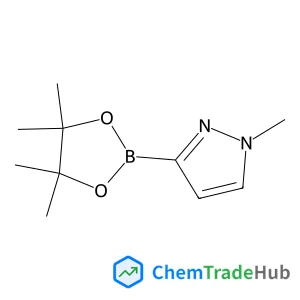
1-Methyl-3-(4,4,5,5-tetramethyl-1,3,2-dioxaborolan-2-yl)-1H-pyrazole
CAS Number:
1020174-04-2
Molecular Formula:
C10H17BN2O2

Recommended Suppliers





Disclaimer
This page provides academic journal information for reference and research purposes only. We are not affiliated with any journal publishers and do not handle publication submissions. For publication-related inquiries, please contact the respective journal publishers directly.
If you notice any inaccuracies in the information displayed, please contact us at support@chemtradehub.com. We will promptly review and address your concerns.